

A good client recently asked me for an update on the technology supporting SBA 7(a) lending — who the vendors are, what they actually do, who owns them, and where the market is heading. It was a timely question, and the answers surprised even us in a few places. Rather than keep the findings to one engagement, we are sharing them here for the broader community of banks and credit unions building or scaling an SBA program.
SBA 7(a) underwriting support technology comprises the platforms and tools that help banks and credit unions originate loans under the Small Business Administration's 7(a) program, which provides up to $5 million in financing for small businesses. These solutions manage application intake, document collection, financial spreading, global cash flow analysis, eligibility screening under SOP 50 10, credit decisioning, form generation (e.g., SBA Forms 1919 and 1920), E-Tran integration for guaranty submissions, and closing. They are critical for lenders to navigate complex SBA requirements, reduce manual errors, and scale origination while ensuring compliance to maintain the SBA guaranty, which can be forfeited due to improper origination, closing, servicing, or liquidation. This Spotlight focuses on the origination and underwriting side of the lifecycle; it complements our September 2025 Sector Spotlight on SBA 7(a) loan origination and servicing systems.
Demand for 7(a) lending remains strong, and the reinstatement of more rigorous underwriting requirements under SOP 50 10 8 — replacing the prior "do what you do" standard — has raised the bar for documentation, analysis, and consistency across every file. Banks originate the large majority of 7(a) volume, but credit unions have meaningfully expanded participation, and both face the same operational reality: the 7(a) file is document-heavy, eligibility-sensitive, and unforgiving of process error, which makes underwriting throughput — not credit appetite — the binding constraint for most institutions entering or scaling the program.
The most important structural development in this market is that "SBA lending technology" has split into two distinct layers, and buyers who conflate them end up with apples-to-oranges shortlists. The first layer is the origination system of record — the platform that owns the file, runs the workflow, submits guaranty requests to E-Tran, and carries the loan into servicing; replacing one is a multi-month project. The second layer is the underwriting and analysis layer — the analyst work inside the file: document classification, tax return spreading with K-1 tracing across affiliates, global cash flow construction, guarantor analysis, and credit memo assembly. Tools in this layer deploy alongside the incumbent system of record, often in weeks rather than months, and this is where the newest entrants and the venture investment are concentrated. Live Oak Bank and Huntington, the two largest 7(a) lenders, are both integrating generative AI into their SBA operations, a signal that AI-assisted underwriting has moved from experiment to production. Supervisory expectations are evolving in parallel: examiners increasingly look for source page citations, preserved human override history, and a documented model risk owner wherever AI touches the credit decision.
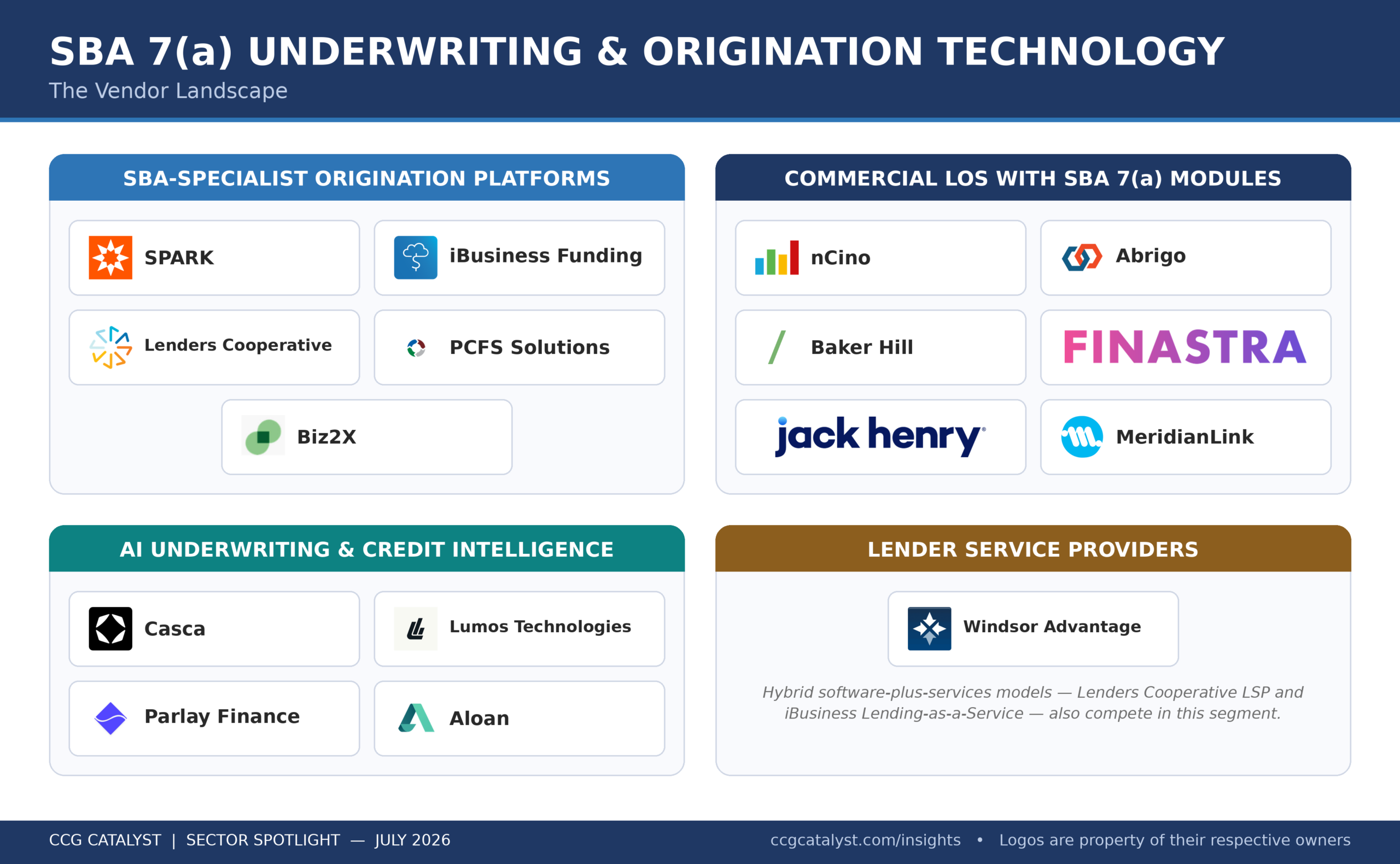
The SBA 7(a) underwriting and origination technology vendor landscape, July 2026. Logos are property of their respective owners. This list is not exhaustive and does not include all vendors in the space — if you are a vendor not featured here, please contact us so we can consider updates.
SPARK — Loan Origination Software: SaaS-based platform that digitizes 7(a) origination end to end, supporting Express loans with delegated processing and a four-week onboarding. Incubated within Community Reinvestment Fund, USA (CRF), the Minneapolis-based CDFI, and acquired in June 2023 by Arcadea Group, a Toronto-based long-hold software investor — a permanent-capital owner rather than a traditional PE flip. Targets banks, LSPs, and mission-driven lenders of all sizes; clients include The Bancorp, Bank of Idaho, American Bank & Trust, and NDC's Grow America Fund.
Website: www.lendwithspark.com
iBusiness Funding — LenderAI: End-to-end SBA platform spanning sales through servicing, built on interpretable, auditable AI, with native E-Tran integration and the Prodigy SOP chatbot; also offers Lending-as-a-Service for outsourced fulfillment. Founded in 2015 by Justin Levy and wholly owned since 2019 by Ready Capital Corporation (NYSE: RC), itself one of the nation's largest 7(a) lenders — a channel consideration banks should weigh, since the platform owner competes for the same borrowers. Fort Lauderdale-based with 350+ employees; LenderAI has facilitated over $7 billion in loan volume, serves 1,800+ users, and processes 1,200+ business loan applications daily. Acquired Funding Circle US (2024) and launched the Lendsey agentic AI with a $100 million AI commitment (2025).
Website: www.ibusinessfunding.com
Lenders Cooperative / Ventures (Summit Technology Group): Founded in 2019 within Summit Technology Group (STG), the Mechanicsburg, PA-based lending technology firm whose investors have included the American Bankers Association; in 2023 the platform opened equity ownership to its client institutions under a "built by lenders, for lenders" cooperative model, and in February 2025 it completed its merger with Ventures Lending Technologies, a longtime SBA software specialist serving CDCs, banks, credit unions, LSPs, and CDFIs. Distinctive in pairing technology with professional services — credit analysis, closing, SBA LSP support, and servicing — so institutions can buy underwriting capacity alongside the platform. Serves 140+ financial institutions; named clients include Cape Cod 5, Penn Community Bank, Primis Bank, and Lafayette Federal Credit Union.
Website: www.lenderscooperative.com
PCFS Solutions — BizLendPro / Loan Manager: Long-tenured, privately held SBA specialist based in Brea, California, offering a product suite spanning the full lifecycle: BizLendPro for 7(a) origination (underwriting, packaging, E-Tran submission, DocuSign e-signatures), Loan Manager for servicing (loan accounting, tickler tracking, automated 1502 reporting reconciled to the FTA), and Special Assets Manager for workout and liquidation, including automated SBA 10-Tab guaranty files. Used by hundreds of lenders including banks, LSPs, credit unions, and CUSOs; named clients include Meadows Bank and American Business Lending.
Website: www.pcfssolutions.com
Biz2X — Accelerate SBA: Subsidiary of Biz2Credit, the New York fintech founded in 2007 by CEO Rohit Arora, which has facilitated more than $10 billion in small business financing. Accelerate SBA covers 7(a), Express, 504, CAPlines, and microloan origination with E-Tran connectivity, AI-driven decisioning, configurable credit-policy rules, and omnichannel applications, with a rapid-launch version deployable in roughly 30 days for banks entering SBA lending. Clients include HSBC Bank USA, Popular Bank, Newity (with Northeast Bank), Republic Bank of Arizona, and First Savings Bank. Note that Biz2Credit's funding subsidiary, Itria Ventures, is itself a direct small business funder — a channel consideration similar to iBusiness/Ready Capital.
Website: www.biz2x.com
nCino: Publicly traded (NASDAQ: NCNO), headquartered in Wilmington, NC. Cloud-based bank operating system with SBA-specific workflows across 7(a), 504, and Express, including a pre-built SBA eligibility engine with automated guaranty calculations and compliance checks, integrated with core banking systems. Best suited to mid-size and larger institutions with high volumes.
Website: www.ncino.com
Abrigo — SBA Lending Solution: Austin-based platform formed from the combination of Sageworks, Banker's Toolbox, and MainStreet Technologies; co-majority owned by Accel-KKR (invested 2015) and Carlyle (2021 strategic growth investment at a $1 billion-plus valuation). Streamlines 7(a) origination with E-Tran integration, form generation (1919/1920), automated underwriting workflows, risk grading, and portfolio monitoring, and fits naturally where institutions already run Abrigo's credit, CECL, and AML stack.
Website: www.abrigo.com
Baker Hill: Founded in 1984 and headquartered in Carmel, Indiana; acquired in June 2023 by private equity firm Flexpoint Ford from The Riverside Company, with CEO John Deignan and management remaining as shareholders. The NextGen platform serves 400+ financial institution clients across commercial and small business LOS with SBA support and embedded decisioning, and its partnership with Lumos Technologies embeds the Prime+ predictive credit model — an example of the underwriting-intelligence layer being distributed through incumbent LOS channels.
Website: www.bakerhill.com
Finastra: London-based enterprise fintech owned by Vista Equity Partners, with SBA origination, underwriting, servicing, and reporting for 7(a) and 504, including E-Tran integration, automated workflows, and audit trails. Finastra is amid a multi-part divestiture program across its lending and universal banking businesses; buyers should confirm where the SBA product line and its roadmap land post-divestiture before committing.
Website: www.finastra.com
Jack Henry — Commercial Lending Suite: Publicly traded (NASDAQ: JKHY), headquartered in Monett, Missouri. SBA origination, underwriting, and compliance support differentiated by deep native integration with the SilverLake and Symitar cores — a meaningful advantage for banks and credit unions already on Jack Henry rails.
Website: www.jackhenry.com
MeridianLink: Irvine, California-based lending platform serving roughly 2,000 community financial institutions and consumer reporting agencies; taken private by Centerbridge Partners in October 2025 in a $2.0 billion transaction (with a Silversmith Capital Partners minority stake) and delisted from the NYSE. SBA-capable within a broader consumer and small business lending suite; strongest with institutions prioritizing compliance reliability and established core integrations.
Website: www.meridianlink.com
Casca: Venture-backed AI-native loan origination system that automates roughly 90% of manual effort in business loan origination, with 30+ native data integrations and automated analysis of tax returns, bank statements, and financial statements. Canapi Ventures led its $29 million Series A, and Live Oak Bank and Huntington — the two largest 7(a) lenders — are integrating Casca's generative AI for SBA lending; named to American Banker's 2026 Best Fintechs to Work For. The most credentialed AI-native entrant in the category.
Website: www.cascading.ai
Lumos Technologies — Prime+: Founded in 2022 in Wilmington, NC by former Live Oak Bank executives Brett Caines (CEO) and Youri Nelson (CTO), with pre-seed backing from Summit Technology Group and a seed round joined by Live Oak chairman Chip Mahan. Prime+ delivers probability of default, loss given default, and expected loss scoring for small business loans under $500,000, built on three decades of performance data spanning two million loans; the Lumos Business Report automates AI-driven business write-ups and credit memo elements. Delivered via API into LOS platforms including Lenders Cooperative and Baker Hill; used by more than 80 financial institutions.
Website: www.lumosdata.com
Parlay Finance: Founded in 2022 and headquartered in Alexandria, Virginia, led by CEO Alex McLeod; raised a $2 million seed round led by JAM FINTOP (June 2025), the bank-backed fintech fund, with partnerships including Mastercard Small Business and Stratyfy. Its Loan Intelligence System sits at the front of the funnel — digital onboarding, information verification, eligibility screening, and SBA borrower readiness — complementing the incumbent LOS. Named bank clients include Locality Bank and First Internet Bank, which reports efficiency gains of up to 50% in its SBA operation.
Website: www.parlay.finance
Aloan: Very early-stage entrant (Aloan Inc., Houston, Texas; pre-seed) founded by Mitch Barnard, Andrew Blake, Tim Diamond, and Gerrit Yntema, combining commercial lending experience with engineering backgrounds from Google, Apple, Meta, and X. Publicly launched in March 2026 and demoed at FinovateSpring 2026, the platform automates the analyst layer — document classification, spreading with K-1 tracing, global cash flow, and source-cited credit memos — alongside the incumbent LOS. The company states it is live with lenders in the US and Canada but has not publicly named clients, and much of its market visibility comes from its own comparison content; institutions evaluating it should apply early-stage vendor diligence accordingly.
Website: www.aloan.ai
Windsor Advantage — SBA Lender Service Provider: Founded in 2010 and headquartered in Chicago (with offices in Charleston and Indianapolis), Windsor is the nation's largest SBA Lender Service Provider, serving 150+ financial institution clients across 38 states with outsourced 7(a) and USDA origination support, underwriting, portfolio servicing (approximately $2.5 billion), liquidation, and 1502 compliance. Formerly a subsidiary of Integrated Financial Holdings, Windsor became a subsidiary of Capital Bancorp, Inc. (NASDAQ: CBNK), parent of Capital Bank, N.A., when the IFH merger closed in October 2024 — meaning the leading LSP is now bank-owned, and prospective clients should assess the same channel considerations that apply to lender-owned platforms.
Website: www.windsoradvantage.com
Hybrid software-plus-services models: Lenders Cooperative's LSP service and iBusiness Funding's Lending-as-a-Service allow institutions to combine platform technology with variable-cost underwriting capacity — an increasingly common model that blurs the line between buying software and buying fulfillment.
If you are a buyer, ensure you have defined business and functional requirements to align the solution with your specific needs in SBA lending — and be explicit about which layer you are buying. If the institution lacks an SBA system of record, the shortlist is the origination platforms or an LSP; if a system of record exists but files still drag, the bottleneck is usually analyst capacity, and the shortlist is the underwriting layer.
SBA Guaranty Compliance: Robust E-Tran integration for guaranty submissions, automated form generation (1919/1920), and 1502 reporting to prevent guaranty forfeiture, with eligibility screening aligned to the current SOP 50 10 8 underwriting standards.
Underwriting Depth: Financial spreading with K-1 tracing across affiliates, global cash flow construction, guarantor and entity-structure analysis (including EPC/OC structures), and credit memo assembly — the analyst work where most 7(a) files actually stall.
AI Auditability: Source-page citations behind AI-generated analysis, preserved human override history, and a documented model risk owner inside the institution, consistent with supervisory expectations for AI in credit decisioning.
Express Loan Support: Streamlined workflows for 7(a) Express loans (up to $500,000) with delegated authority for faster processing and reduced documentation.
Target Lender Fit: Scalability and cost-effectiveness for community banks and credit unions (under $10B assets), or enterprise integration depth for regional institutions expanding SBA portfolios; core and LOS integration fit should be validated, not assumed.
Vendor Ownership and Channel Conflict: Nearly every vendor in this category now sits inside a larger capital structure — private equity (Baker Hill/Flexpoint Ford, Abrigo/Accel-KKR and Carlyle, MeridianLink/Centerbridge, Finastra/Vista), a public REIT-lender (iBusiness/Ready Capital), a bank holding company (Windsor Advantage/Capital Bancorp), a direct SMB funder (Biz2X/Biz2Credit), or a long-hold investor (SPARK/Arcadea). Diligence should cover ownership stability, roadmap commitment, and whether the platform owner competes for the same borrowers.
Total Cost of Ownership: Platform contracts, per-loan LSP pricing, and volume-based AI subscriptions carry very different cost shapes at different origination volumes; model TCO against your actual projected 7(a) volume, not vendor assumptions.
For expert guidance on selecting and implementing these solutions, consider consulting with firms like CCG Catalyst, who specialize in navigating the financial services ecosystem to match your unique requirements.
See our latest announcement: CCG Catalyst's Paul Schaus Named a 2026 Top Consultant by Consulting Magazine
By: Paul Schaus | Founder & Managing Partner, CCG Catalyst Consulting
CCG Catalyst's Sector Spotlights highlight third-party solutions, products, and the companies that offer them. They provide a snapshot of the innovations, trends, and key players in the financial services ecosystem.