

Yesterday, in my article What Is a CRM, Anyway? we made the argument that the definition is the decision — that CRM projects succeed or fail before the contract is signed, on whether the institution defined the assignment as a sales tracker, a marketing engine, or the front end of the bank. The piece was The Why. This Spotlight is The Who: the vendor landscape behind the decision.
CRM systems for banks and credit unions comprise the platforms that manage customer and member relationships across the institution, unifying data from the core, digital banking, lending, and contact center systems into a single view of the relationship, and putting that view to work in service, referrals, cross-sell, onboarding, and retention. Unlike generic sales CRM, financial institution CRM lives or dies on bi-directional core integration, household and relationship data models, role-based workflows for branch, contact center, and lending teams, and compliance-aware marketing automation. Done well, it is the connective tissue between the core and the customer; done poorly, it is the most expensive shelfware in the building.
The category is consolidating into adjacent stacks and the buyers' map is being redrawn as a result. In March 2026, Abrigo acquired 360 View, one of the longest-tenured purpose-built banking CRMs (founded 2001, "made by bankers, for bankers"), pulling relationship management into the same platform as credit risk, lending, and compliance analytics. It is a signal worth reading carefully — CRM in financial institutions is increasingly bought not as a standalone sales tool but as the front end of a data and analytics strategy. Existing 360 View customers keep uninterrupted support, but the roadmap now answers to Abrigo's priorities, something for institutions to weigh at renewal.
Meanwhile the enterprise platforms are pushing down-market. Salesforce's Financial Services Cloud Accelerator packages pre-configured use cases specifically for community banks, credit unions, and CDFIs under $10 billion in assets, paired with its Agentforce agentic AI — an explicit answer to the historical objection that Salesforce was too costly and too heavy for community institutions. Purpose-built specialists are countering on fit: BUSINESSNEXT was named a Leader in the Forrester Wave for financial services CRM in early 2025, scoring ahead of both Salesforce and Microsoft in that evaluation, on the strength of banking-native data models and pre-built FI workflows. And the perennial truth of this category remains — most CRM failures in banking are not software failures but adoption failures. Frontline teams will not use a system that is not wired into the core and their daily workflow, which is why core integration depth, not feature count, should anchor any evaluation. Two further patterns round out the map: three of the four major US core providers — Jack Henry, Fiserv, and CSI — now field their own CRM offerings, keeping relationship data inside the core franchise, while FIS conspicuously does not, taking a partner-led approach through Salesforce and nCino. And the boundary between CRM, marketing data platforms, and customer communications keeps blurring, with players like Marquis and Doxim selling relationship management as part of broader marketing and communications stacks.
The deeper pass behind this expanded edition surfaced the pattern most evaluations miss: in commercial banking, the de facto CRM is frequently the lending platform. At many of nCino's institutions, relationship managers run pipelines, referrals, and client lifecycles inside a Salesforce-based banking platform that was purchased as loan origination. Baker Hill ships a genuine CRM inside its NextGen lending suite for the same reason. The consequence for buyers is real — the CRM evaluation and the commercial LOS evaluation are often the same decision wearing two names, and institutions that run them separately end up paying for two relationship systems their bankers refuse to reconcile. Beneath it all sits a relationship-intelligence layer — White Clay being the clearest example — that answers the question CRMs record but cannot answer: which relationships are actually profitable, and what should this one cost?
Finally, watch where the new fintech energy is entering, because it is not entering through classic CRM. The startups drawing attention in this category are AI-native customer data platforms, personalization engines, and conversational relationship AI built for community institutions: unifying member data across core, LOS, and digital banking, predicting churn and next products, personalizing digital experiences to a segment of one, and at the earliest edge deploying AI agents that build the relationship conversationally across the lifecycle. None of them sells a system of record; all of them sell what makes the system of record worth having. For buyers, that reframes the roadmap question: the CRM you choose must be able to consume what this new layer produces.
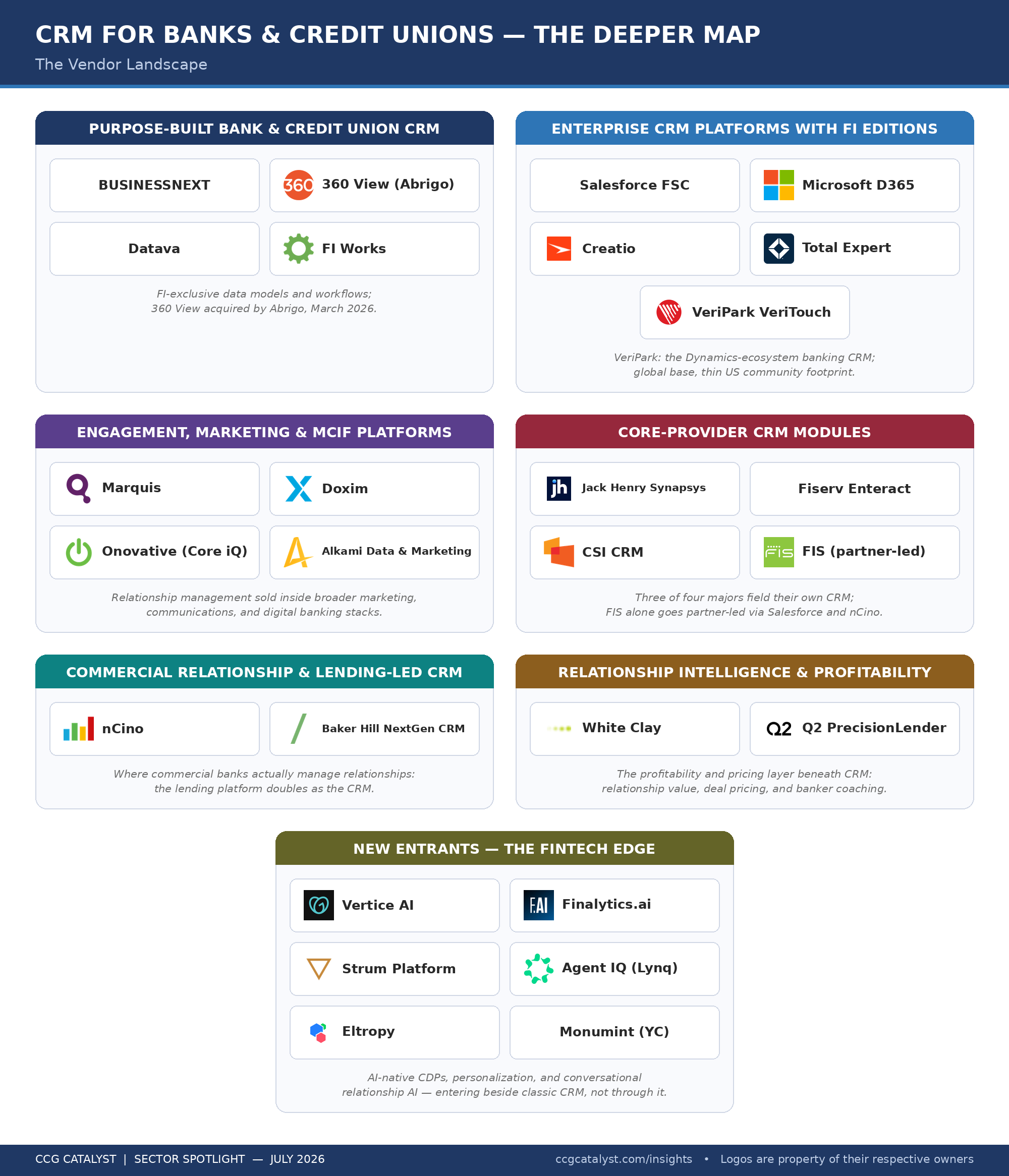
The bank and credit union CRM vendor landscape, July 2026. Logos are property of their respective owners. This list is not exhaustive and does not include all vendors in the space — if you are a vendor not featured here, please contact us so we can consider updates.
BUSINESSNEXT (formerly CRMNEXT): Purpose-built CRM serving the banking and credit union industry exclusively, with bi-directional core integration, a banking-native member/customer data model, role-based dashboards, and no-code workflow design; the company implements its own software with an in-house delivery team. Part of the global BusinessNext organization (founded in India as CRMNEXT), which states that four of the five largest banking CRM implementations in the world run on its platform; named a Leader in the Forrester Wave for financial services CRM, Q1 2025, ahead of Salesforce and Microsoft in that evaluation. US clients include O Bee, Westmark, SESLOC, Magnifi Financial, Foothill, General Electric, and State Department Federal credit unions.
Website: www.businessnext.us
360 View (Abrigo company): Founded in 2001 with a "made by bankers, for bankers" approach, 360 View unifies customer data, referral and pipeline workflows, marketing automation, and account/portfolio profitability analytics for banks and credit unions. Acquired by Abrigo in March 2026, folding relationship intelligence into Abrigo's compliance, credit risk, lending, and analytics suite serving 2,400+ financial institutions; existing customers continue with uninterrupted support, though the long-term roadmap now aligns to Abrigo's data and analytics strategy.
Website: www.360view.com
Navanta CRM (formerly Quest Analytics): Purpose-built CRM and customer engagement platform serving banks and credit unions, founded in Pittsburgh as Quest Analytics with an emphasis on the community banking market — a 360-degree view of the client relationship, prospect and lead tracking, pipeline, referral, and service-ticket management, marketing and campaign automation, and goal and incentive management, built on a banking-specific data model. Navanta reports 50 institutions on the CRM. The evaluation note buyers should weigh: the platform works across cores via a nightly batch import rather than real-time bi-directional integration. Apply the core-integration test above accordingly.
Website: www.navanta.com
Datava: A CUSO-built platform for community financial institutions, offering modular CRM components that adapt to an institution's existing technology stack. A smaller entrant, but notable as one of the few credit-union-owned options in the category.
Website: www.datava.com
FI Works: Little Rock, Arkansas-based provider of purpose-built sales and marketing software for banks and credit unions — customer data aggregation, lead scoring and next-best-product analytics, campaign execution, and frontline sales workflow, under the tagline "sales and marketing you can bank on." Founder-led (CEO Keith Henkel, ex-Systematics/FIS lineage) and privately held, the company launched AI-driven analytics delivering real-time insights for banks and credit unions in April 2026 and distributes in part through a strategic partnership offering its Customer Data Platform to Baker Hill's 400+ institution client base; named clients include University Credit Union. A smaller entrant, but one of the few remaining independent, banking-only CRM platforms after 360 View's move to Abrigo — worth watching for exactly that reason.
Website: www.fiworks.com
Salesforce — Financial Services Cloud: The enterprise standard, with a dedicated Financial Services Cloud data model and, critically for this audience, the FSC Accelerator for community banks, credit unions, and CDFIs — pre-configured use cases for deposit growth, onboarding, service, and referrals aimed at institutions under $10 billion in assets — plus Agentforce agentic AI across service and sales. Strongest where the institution wants a platform strategy and has the resources to govern it; total cost and configuration weight remain the biggest objections for smaller institutions.
Website: www.salesforce.com/financial-services
Microsoft Dynamics 365: Microsoft's CRM and ERP platform, widely deployed in institutions standardized on the Microsoft stack, with financial services accelerators and a deep ecosystem that delivers banking-specific solutions on top of it, including Fiserv's Enteract, profiled below. Viable and cost-effective for Microsoft-centric institutions, but banking fit depends heavily on the implementation partner and customization investment.
Website: www.microsoft.com/dynamics-365
VeriPark — VeriTouch: The other major banking CRM built on Microsoft Dynamics 365. VeriTouch is a customer-engagement CRM built exclusively for financial services — banking-native data model, onboarding, next-best-action, complaints, and loyalty delivered on Microsoft Cloud for Financial Services and available through the Microsoft marketplace. Privately held and founded in 1998, VeriPark was recognized in Forrester's 2024 financial-services CRM landscape. The caveat for this audience: its deployment base skews global — large banks across EMEA and Asia — and its US community-institution footprint is thin, so treat it as the Dynamics-ecosystem option for institutions that want banking depth on the Microsoft stack rather than a community-bank incumbent.
Website: www.veripark.com
Creatio: AI-native, no-code CRM and workflow platform with a dedicated financial services vertical for banks and credit unions, including pre-built workflows for deposit accounts, lending, cards, and contact center. Boston-based and venture-backed, Creatio raised $200 million in 2024 at a $1.2 billion valuation led by Sapphire Ventures; US FI clients include Cornerstone Bank, Lake City Bank, State Bank of Southern Utah, Jersey Shore Federal Credit Union, Ent Credit Union, and Generations. Frequently evaluated as the cost-and-configurability alternative to Salesforce.
Website: www.creatio.com
Total Expert: Minneapolis-based "Customer Operating System" founded in 2012 by CEO Joe Welu; venture-backed with roughly $86 million raised through a Series C led by Georgian, with Emergence Capital, Rally Ventures, and Arthur Ventures. Purpose-built for financial services with compliance-aware content and journey automation, it powers engagement for 200+ financial institutions including 15 of the top 25 US banks and lenders. Mortgage-rooted and expanding deliberately into banks and credit unions (including a Cooperative Credit Union Association partnership), it is the strongest fit where marketing-led growth, not service workflow, is the primary objective; it also offers a Salesforce integration for institutions running both.
Website: www.totalexpert.com
Marquis: The MCIF standard-bearer: Plano, Texas-based since 1987, serving over 400 banks and credit unions with data analytics, MCIF/CDP, an integrated CRM, marketing automation, and CRA/HMDA/Fair Lending compliance — a combination no other vendor in this landscape offers under one roof. Jointly acquired in November 2021 by Rockbridge Growth Equity and CU Solutions Group, the Michigan-based CUSO, giving it a distinctive credit-union-aligned ownership stake; subsequent acquisitions include DocuMatix (email and marketing automation) and ZAG Interactive (FI website design). Best fit where marketing analytics and compliance reporting matter as much as frontline CRM workflow.
Website: www.gomarquis.com
Doxim: Markham, Ontario-based customer communications and engagement provider, majority-owned by GI Partners since 2018, serving 2,500+ clients across banks, credit unions, and wealth managers with a suite spanning customer communications management, enterprise data, account opening, and a CRM module with deep credit union heritage. Led by CEO Mike Hennessy since 2024 and built partly through 11 acquisitions. Its center of gravity is communications rather than frontline relationship workflow.
Website: www.doxim.com
Onovative — Core iQ: Louisville, Kentucky-based provider of Core iQ, a deliberately simple core-integrated marketing and communication platform for community banks and credit unions — onboarding communications, email/print/SMS campaigns, cross-sell triggers, and surveys. Founded in 2012 and acquired in August 2020 by Main Street, Inc., the Birmingham-based bank marketing and check-services provider. The lightweight, low-lift option for institutions that need automated account-holder communication before they need a full CRM.
Website: www.onovative.com
Alkami — Data & Marketing Solutions: Alkami, the digital banking provider, acquired data-analytics and personalization firm Segmint in 2022 and now sells a Data & Marketing Solutions suite — transaction-data enrichment, behavioral Key Lifestyle Indicators, audience segmentation, and campaign activation — alongside its 2026 launch of a Digital Sales & Service Platform embedded directly in digital banking. It belongs on this map for a structural reason: it is the clearest example of digital-banking-led relationship management, the third door into the CRM decision after core-led (Jack Henry, Fiserv, CSI) and lending-led (nCino, Baker Hill). For institutions that have Alkami digital banking, the CRM evaluation should start by asking what this layer already covers.
Website: www.alkami.com
Jack Henry Synapsys: Jack Henry's relationship management solution, actively marketed in 2026, automating CRM, service and event tracking, referrals, and sales and marketing initiatives with native integration to the SilverLake, CIF 20/20, and Core Director cores. The default consideration for Jack Henry institutions: lighter than the dedicated platforms but wired into the core by construction and priced accordingly.
Website: www.jackhenry.com
Fiserv Enteract: Fiserv's own CRM, launched in 2021, built on Microsoft Dynamics 365 and delivered by Fiserv through the Microsoft cloud, with a banking data model and a real-time integration framework wired into core account processing, loan origination, content management, and digital channels. Aimed at regional banks and larger community institutions on Fiserv cores.
Website: www.fiserv.com
CSI CRM: Computer Services, Inc., the core provider taken private by Centerbridge Partners and Bridgeport Partners in 2022, offers CSI CRM fully embedded within its NuPoint® core — and functionally it is a true CRM, not merely a customer dashboard: contact and interaction tracking with notes, reminders, and email; relationship linking and grouping for a household-style view; case and complaint tracking with multi-step workflows and real-time notifications; referral and opportunity management with automatic routing and pipeline reporting; and campaign execution across email, print, phone, and on-screen prompts using CSI IQ target lists. In May 2026 CSI layered on its Customer Intelligence Suite, embedding AI-driven "Signals" from core, Apiture digital banking, and Velocity analytics data directly into the CRM. The defining constraint is distribution, not function — it is available only inside the NuPoint core, cannot be bought standalone, and NuPoint is a bank platform.
Website: www.csiweb.com
FIS: FIS, alone among the major US core providers, does not field its own CRM. Its approach is partner-led — FIS exposes its cores (IBS, Horizon, and others) through the Code Connect API marketplace, and the CRM layer is supplied by Salesforce Financial Services Cloud or nCino, implemented by integration partners such as Mphasis Silverline and Access Global Group, typically over MuleSoft or direct API patterns. For FIS-core institutions this means more choice and more integration risk in the same decision: the CRM evaluation and the systems integrator evaluation are inseparable, and integration scope — not license cost — usually drives the true TCO.
Website: www.fisglobal.com
nCino: For many of nCino's 2,700+ institutions, the lending platform is the CRM solution. Built on Salesforce, nCino carries Salesforce's relationship data model into a banking-native platform — client lifecycle management from prospecting through onboarding (KYC/AML included) to ongoing relationship management, with pipelines, referrals, and customer engagement unified with commercial and retail loan origination, and nIQ layering AI-driven insights on top. For institutions where lending is the primary entry point to new relationships, nCino is frequently the de facto CRM decision, made inside the lending evaluation, sometimes without being named as one. If your institution lives in nCino, a separate CRM purchase must justify itself against what they already have.
Website: www.ncino.com
Baker Hill — NextGen CRM: A true banking CRM inside a unified lending platform. Baker Hill NextGen® combines commercial and consumer loan origination, portfolio risk management, and purpose-built CRM — contacts, call activity and touch history, sales opportunities prioritized by probability and stage, client-specific relationship plans, referral management, and client value-and-risk views — with omnichannel marketing analytics alongside. Carmel, Indiana-based, founded in 1984, owned by Flexpoint Ford, and serving roughly 500 financial institutions with particular strength in business and member business lending. The strongest fit where relationship management should live is where the lending happens — and a frequent answer for institutions that found generic CRM adoption failing among commercial lenders.
Website: www.bakerhill.com
White Clay: Not a CRM — this is the layer beneath one, and often the reason a CRM finally earns its keep. Louisville-based since 2006 and founder-led (Mac Thompson, ex-Bank of America and Chase), White Clay aggregates disparate core and ancillary data into complete relationship profiles, adds client profitability, behavior, and relationship-deepening intelligence, and gives bankers pricing and sales tools aligned to shareholder value. Partnerships span Salesforce and S&P Global, and a November 2025 collaboration embeds Curinos' commercial pricing benchmarks into its deal-pricing tools. Named users include Encore Bank and Financial Plus Credit Union. The evaluation question it answers is the one most CRMs cannot: which relationships are actually worth deepening, and at what price.
Website: www.whiteclay.com
Q2 — PrecisionLender: The commercial-side companion to White Clay in this category. PrecisionLender is Q2's relationship pricing and profitability platform — acquired in 2019 — that gives commercial relationship managers deal-level pricing intelligence in the moment of structuring: relationship profitability, pricing scenarios, and coaching from its intelligent virtual analyst, Andi®, embedded in the negotiation workflow. Used by some of the largest US banks and institutions of all sizes. Like White Clay, it answers the question a CRM records but cannot answer — what a relationship is worth and what this deal should cost — and for Q2 digital-banking institutions it arrives with platform synergies.
Website: www.q2.com
Vertice AI: AI-powered account-holder growth and customer data platform for community banks and credit unions — segmentation, churn prediction, next-product recommendations, and targeted campaign execution built on the institution's existing customer and member data, plus Vertice COMPOSE, an AI copywriting tool with compliance standards, including NCUA alignment, embedded. Its distribution runs deepest in the credit union market: partnered with Vizo Financial, the corporate credit union, to bring advanced analytics to member credit unions of all sizes and named by CU 2.0 as its top standalone CDP choice for credit unions.
Website: www.verticeanalytics.ai
Finalytics.ai: Real-time "segment of one" personalization engine for community banks and credit unions, orchestrating individualized content and product journeys across the marketing site, digital banking, applications, and email based on modeled intent — without requiring PII for anonymous visitors. Visions Federal Credit Union reports conversion-rate increases above 270% on the platform, and the firm's annual Credit Union Digital Experience Report ranking the top 100 CU digital experiences has become a category benchmark in its own right.
Website: www.finalytics.ai
Strum Platform: Credit-union-focused customer data platform and analytics layer — unified member profiles with next-day data, marketing ROI measurement, and Power BI-native dashboards — from the Strum agency family, pairing the data platform with brand and growth strategy services. The pragmatic entry point for institutions that want CDP economics before CDP complexity.
Website: www.strum.com
Agent IQ: San Francisco-based relationship-banking platform whose Lynq product gives every customer a persistent, named personal banker inside digital channels, combining human bankers with AI assistance rather than replacing them. Venture-backed ($10 million Series A led by Mendon Venture Partners, with Sierra Ventures and bank investors including FNBO) and distributed in part through an expanded partnership with Q2. The relationship-first counterpoint to chatbot-style engagement: the pitch is fewer deflections, more conversations with the same banker.
Website: www.agentiq.com
Eltropy: Milpitas, California-based, venture-backed ($25 million Series A) unified conversations platform serving 750+ credit unions and community banks — text, video, chat, voice, and co-browsing on one platform — which in 2026 launched what it positions as the industry's first agentic AI platform for credit unions and opened it to third-party fintechs through an early-access program. Distribution runs deep through the credit union ecosystem, including a CUNA Strategic Services alliance. Not a system of record: it is the engagement layer that increasingly owns the member conversation, which makes it either CRM's best data source or its quiet competitor, depending on how the institution defines the category.
Website: www.eltropy.com
Monumint: The earliest-stage entrant on this map, included as a signal of direction rather than a procurement recommendation: a Y Combinator-backed startup building omni-channel conversational AI agents for banks, credit unions, and lenders that act inside existing systems across the relationship lifecycle — account opening, loan origination, servicing, and collections — with compliance positioned at the core. Watch-list material for where relationship management is headed.
Website: www.monumint.com
Also considered and deliberately left off: HubSpot and Zoho (no financial-institution edition and no native core integration, though HubSpot appears at some de novos and fintech-adjacent charters); Backbase (positions as an engagement banking platform against digital banking, not CRM); and wealth-management CRMs such as Practifi and Redtail.
If you are a buyer, ensure you have defined business and functional requirements and be honest about which problem you are solving. A service-and-referral problem, a marketing-and-growth problem, and a data-and-analytics problem point to different shortlists, and the most common failure mode is buying an enterprise platform for a workflow problem or a marketing tool for a data problem.
Core Integration Depth: Bi-directional, real-time integration with your specific core (not "core integration" in the abstract) is the single strongest predictor of frontline adoption; validate your core, your digital banking platform, and your LOS by name during diligence.
Data Model Fit: Household and relationship structures, member-centricity for credit unions, and business/consumer duality for banks should be native to the platform, not customized in — retrofitted generic data models are where implementations stall.
Adoption and Workflow: Demand role-based demos for the teller line, contact center, lending, and executive dashboards; a CRM that only sales management uses is shelfware with a per-seat license.
AI Governance: Agentic AI and next-best-action engines are now standard claims; require explainability of recommendations, human override history, and clarity on where member data flows — consistent with supervisory expectations for AI touching customer treatment.
Total Cost of Ownership: Per-seat enterprise licensing, platform subscriptions, and core-provider module pricing carry very different cost shapes. Model TCO at your actual seat count and integration scope, including the implementation partner costs that enterprise platforms typically require.
The Lending-Led Question: Before any CRM shortlist, answer one question: where do your relationship-owning bankers already work? If the answer is nCino or Baker Hill, evaluate extending that platform before buying beside it; if the answer is the core, weigh the core-provider module; only if the answer is "nowhere" does a standalone CRM start with a clean slate.
For expert guidance on selecting and implementing these solutions, consider consulting with firms like CCG Catalyst, who specialize in navigating the financial services ecosystem to match your unique requirements.
See our latest announcement: CCG Catalyst's Paul Schaus Named a 2026 Top Consultant by Consulting Magazine
By: Paul Schaus | Founder & Managing Partner, CCG Catalyst Consulting
CCG Catalyst's Sector Spotlights highlight third-party solutions, products, and the companies that offer them. They provide a snapshot of the innovations, trends, and key players in the financial services ecosystem.