


Chartering went from zero to normal and everyone forgot what normal looks like. The numbers behind the "charter boom" headlines, from the OCC's own data, 40 applications in nineteen months, against 45 in the entire nine years before. That is a sevenfold surge and it is also barely a quarter of what a single year produced in 1998. Both facts are true, and which one your board hears determines whether you plan for a gold rush or for something more consequential, a future in which new competition is normal again. The drivers are three OCC actions and one statutory clock. Deregulation is not on the list, and this summer's denials prove it.
I keep being asked whether the chartering boom is real. It is the wrong question. The right question is "real compared to what?"
Compared to the last decade, the surge is enormous. The OCC's own fact sheet — a year-by-year series back to 1990, published in August, shows 22 de novo charter applications received this year through August 5, on top of 18 in 2025. Forty applications in nineteen months. The nine years from 2016 through 2024 produced 45 in total, an average of five a year. Three of the last fifteen years, 2012, 2014, and 2015 produced zero. Not few. Zero. On that baseline, 2026 is running at roughly seven times the prior decade's pace on applications and nine times on approvals.
Compared to any longer-term memory, it is modest. In 1998 the OCC received 138 applications in one year. From 2005 through 2007, an average of 185 new insured banks opened annually — not applied, opened. Eleven insured banks have been opened since the start of 2025. This year's application pace is about 27 percent of the 1998 peak, and the opening rate is roughly 6 percent of the mid-2000s norm.
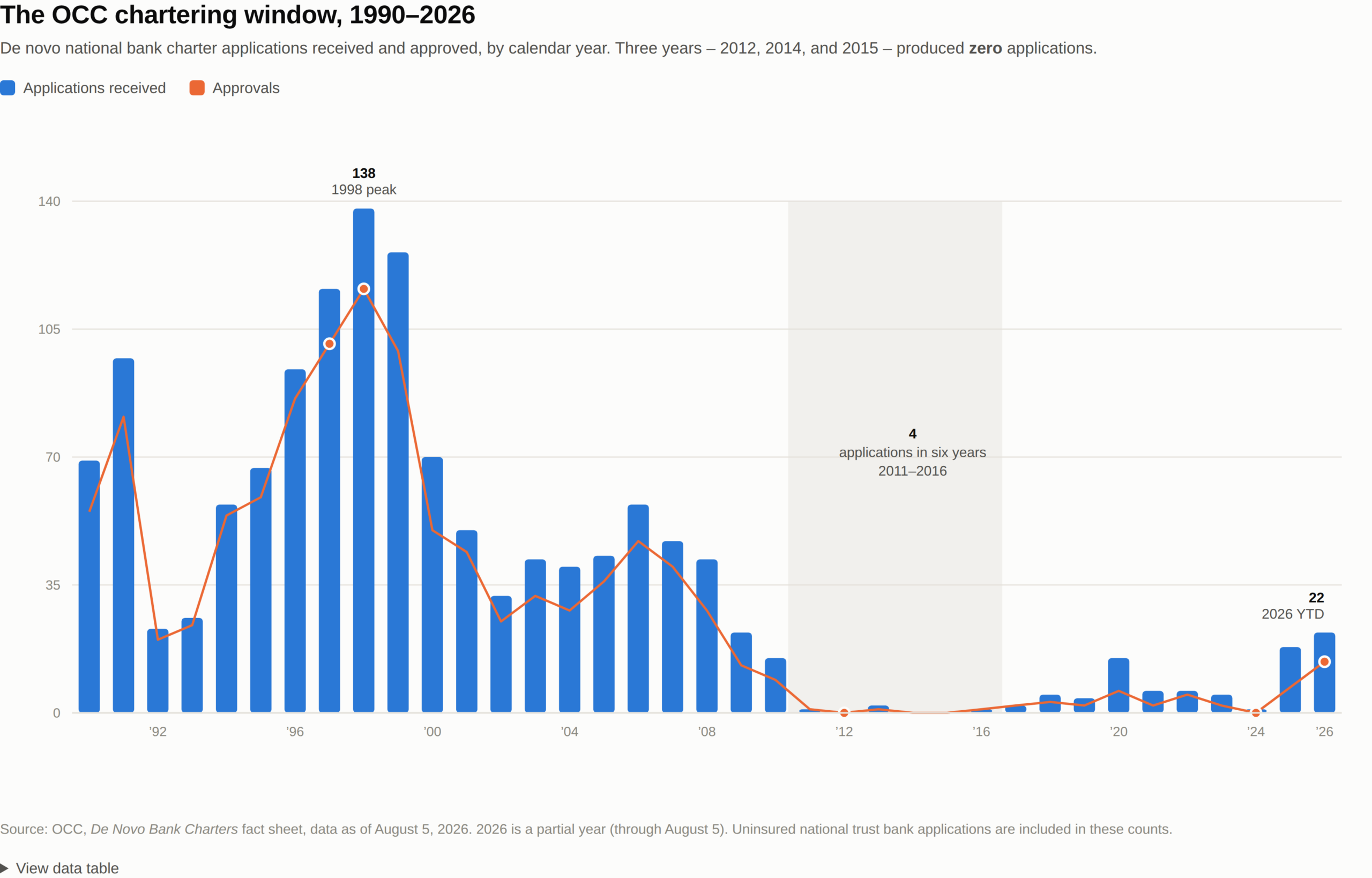
The question — did chartering explode? Applications, yes — sevenfold. Openings, no, seven banks this year, below the 2022 high of fifteen. The gap between those two answers has a specific explanation: most of the new volume is uninsured national trust banks, which never touch the FDIC and never appear in any opening statistic, and twenty-nine institutions currently hold approvals they have not yet used. The pipeline is full; the doors are only starting to open. Comptroller Gould's own phrase for all of this is "a return to the norm", and the forty-year chart says he is right. What the industry has forgotten is that the norm includes new competitors every year.
The honest ranking is shorter than the commentary suggests.
Three OCC actions did most of the work. Interpretive Letter 1183, in March 2025, rescinded the supervisory nonobjection requirement and confirmed that crypto custody and related activities are permissible for national banks, it made the business plans lawful. The National Bank Chartering final rule, effective April 1, rewrote the trust-charter regulation to cover "the operations of a trust company and activities related thereto," removing the legal objection to chartering firms whose business is mostly non-fiduciary custody. And Interpretive Letter 1192, in May, held that a national charter preempts state money transmitter licensing outright, one federal license in place of roughly fifty state ones, which is the single largest economic prize in this cycle. Add a 120-day decision target, and applicants can finally forecast an answer date. People file when they can schedule the outcome.
One statute supplied the deadline. The GENIUS Act caps state-qualified stablecoin issuers at $10 billion, takes effect in January, and ends the runway for non-permitted stablecoins in July 2028. Work an eighteen-to-thirty-month organization timeline backward from those dates and the filing window closes around the middle of next year. The December cluster of applications was not a fashion. It was arithmetic.
And one thing is conspicuously not driving it: a lower bar. This summer the OCC denied Wise's trust application over its AML history, denied bunq's bank application over capital sourcing and management depth and returned a third application as materially deficient. The FDIC's own decisions record shows nearly a quarter of the banks it approved between 2015 and 2019 never opened at all, almost always because the capital raise failed. What changed is permissibility and predictability, the standards did not move. That distinction matters, because "deregulation opened the floodgates" is the frame this wave's critics will use, and the denial record is the rebuttal.
There is one more driver, and nobody puts it in writing because it is impolitic, the political calendar. This administration's regulators are pro-entry, pro-fintech, and openly committed to streamlined processing. The OCC's 120-day decision target, the FDIC's new two-phase insurance process, published denials in place of quiet discouragement says a lot. Contrast with the prior administration is not subtle, from 2021 through 2024 the OCC received twenty-two de novo applications in total — one in all of 2024 — novel charters sat unprocessed, and the signature master-account case of the era ended in denial. Applicants remember. Boards remember.
Every applicant can do the electoral math. Administrations change; the next one arrives in January 2029, and its regulatory posture is unknowable from here. What makes the current rush rational rather than merely opportunistic is an unevenness worth stating plainly: rules can be rewritten, but charters, once granted, endure. A conditional approval that becomes an operating bank is durable across administrations in a way no interpretive letter ever is. The same logic runs through the ILC queue, file now, get grandfathered before Congress or a future FDIC closes the window and through the agencies themselves, which are racing to finish their rulebooks. The SEC proposed its Regulation Crypto Assets on August 18, offering exemptions, an investment-contract safe harbor, and state preemption, on a sixty-day comment clock.
Two honest counterweights. The most important changes of this cycle are statutory, the GENIUS Act, the ROAD to Housing Act and statutes do not flip with the White House. And much of the agency's work rests on thinly staffed boards, which is precisely why sophisticated applicants prefer the charter to the rule. The thinner the board that made the policy, the more valuable the license outlives it. Either way, the practical read for anyone considering this market is the same, windows in banking open rarely, close without notice, and are used hardest in their final years. The filers believe this one has a date on it. Their behavior is the evidence.
Here is why the distinction between gold rush and normal matters in a boardroom.
A gold rush implies a spike, the bank waits it out, and the noise passes. A return to normal implies the opposite, this is the operating environment now. Through the 1990s the industry absorbed roughly a hundred new charters a year, and incumbency meant competing, not merely persisting. The generation of bank executives running institutions today — mine — spent their entire senior careers in the anomaly, the fifteen years when essentially nobody new showed up. Strategic planning at most community banks quietly assumes the competitor set is fixed. That assumption just expired.
The new normal also looks different from the old one. The 1998 class was overwhelmingly local commercial banks. The 2026 pipeline is a barbell, on one end twenty-six ordinary community bank groups, the largest single category and the least covered. On the other hand, uninsured trust charters built to hold payroll float, custody cash, and stablecoin reserves, which will never appear in an opening statistic but compete for balances all the same. Your next competitor may not have a branch, a teller line, or an FDIC certificate. It will still have a federal charter.
The planning questions follow directly. Which of our markets could support a de novo and who in them just got displaced by a merger? Which of our deposit relationships are really another company's client balances, charterable out from under us? And when a well-capitalized newcomer with a 2027 opening date recruits in our market, because the talent for these banks comes from somewhere. What will keep our best lenders home?
Chartering went from zero to normal in eighteen months. The institutions that do well in the next decade will be the ones that remember how to operate as if new entry is ordinary — because for the first time in a generation, it is.
CCG Catalyst advises community and regional banks, credit unions, and fintech companies on strategy, charter decisions, and competitive positioning. If your board is working through what the new formation environment means for your markets, reach out to our team at www.ccgcatalyst.com, or see the full library at CCG Insights.
See our latest announcement: CCG Catalyst's Paul Schaus Named a 2026 Top Consultant by Consulting Magazine
By: Paul Schaus | Founder & Managing Partner, CCG Catalyst Consulting
Disclaimer: The views expressed in this article represent the perspective of CCG Catalyst Consulting based on our direct experience advising financial institutions. This commentary is intended to stimulate industry discussion and does not constitute legal, accounting, or regulatory advice.