

This is an update, and a deliberate one. We first mapped the payment hub category in March 2025, and paired it with a Spotlight on the real-time payment networks themselves that May. Eighteen months later, enough has changed to warrant a fresh landscape rather than a footnote: every rail now runs to a $10 million limit, Gartner published its first Magic Quadrant for the category, the ABA ran its first product assessment, one vendor from our original list changed hands, a new entrant arrived from Brazil, and – as we argued in yesterday’s commentary, “Three Rails, One Number” only about 12% of RTP participants can actually send, which means most of this market’s work is still ahead of it. We apply the same discipline as every Spotlight: confirm every vendor is active, verify who owns them, and name only the clients we can substantiate. Which side of the send divide a bank lands on is, increasingly, a purchase decision.
A payment hub is the software layer that sits between a bank’s core system and the payment networks, so the institution can originate and receive across FedNow, RTP, Fedwire, ACH, and Swift from one platform instead of running a separate connection, operations process, and fraud screen for each rail. The category matters now for a reason the industry has been slow to absorb: receiving an instant payment is a network feature, but sending one is a bank capability – origination controls, fraud screening at the moment of payment, posting to the core in real time, 24/7 operations. That capability is what this market sells. Done well, the hub is how a mid-size institution offers corporate clients the same rails as a money-center bank; done poorly – or not at all – it is why the commercial customer quietly opens an account somewhere that can send.
When we last mapped this category, the payment hub was still an efficiency story, a way to consolidate fragmented rail connections into one integration point. Eighteen months later it is a revenue story, and four developments explain the shift. First, the rails: with RTP and FedNow at $10 million, Same Day ACH following in 2027, and Fedwire’s ISO 20022 migration complete, the business case moved from “someday” to a proforma line and the Fed zeroed its FedNow participation fee for 2026 to remove the last excuse. Second, validation: a category that had no analyst scaffolding when we first covered it now has two rankings – Gartner published its first Magic Quadrant for banking payment hub platforms in January 2026, and the American Bankers Association ran its first product assessment of payment hubs this year while the Fed’s own certified service provider roster has grown to 55 providers, 49 of them certified for both send and receive: the vendor capacity now outruns bank adoption. Third, the roster moved: one platform from our March 2025 list, Dragonfly Financial Technologies' corporate banking business was sold to FIS, Alacriti took new growth capital, and a Pix-proven entrant arrived from Brazil. Fourth, the buyer pool widened downward: what was once money-center technology now reaches community institutions through cloud delivery and the bankers' bank channel. The US Faster Payments Council projects business digital banking platforms going from 18% instant-enabled to 42% by 2028, which is another way of saying more than half this market is still unsold: FedNow’s participant list stands at 1,897 institutions, roughly a fifth of the industry even as the rail just posted its first volume-led quarter, with transactions up 83% and the average ticket falling by nearly half as usage broadens beyond treasury. One more datapoint for the planning file: the Richmond Fed finds 70% of RTP participants have also joined FedNow, dual-rail is becoming the default among institutions that participate at all, which is an argument for buying connectivity once, to both networks, rather than sequencing them. In our April commentary on payments modernization we reported hub adoption at 48% of institutions overall but 98% among banks above $100 billion – this update is written for the other half of the market.
A scope note for readers of the original: several vendors from the March 2025 edition – IBM Payments Center, Euronet’s Ren, Icon Solutions, CGI All Payments, and Finxact – remain in the category, and that edition stands as the fuller roster. This update concentrates on the vendors where we verified US momentum in 2025 and 2026: named client wins, analyst placement, new capital, or new capability.
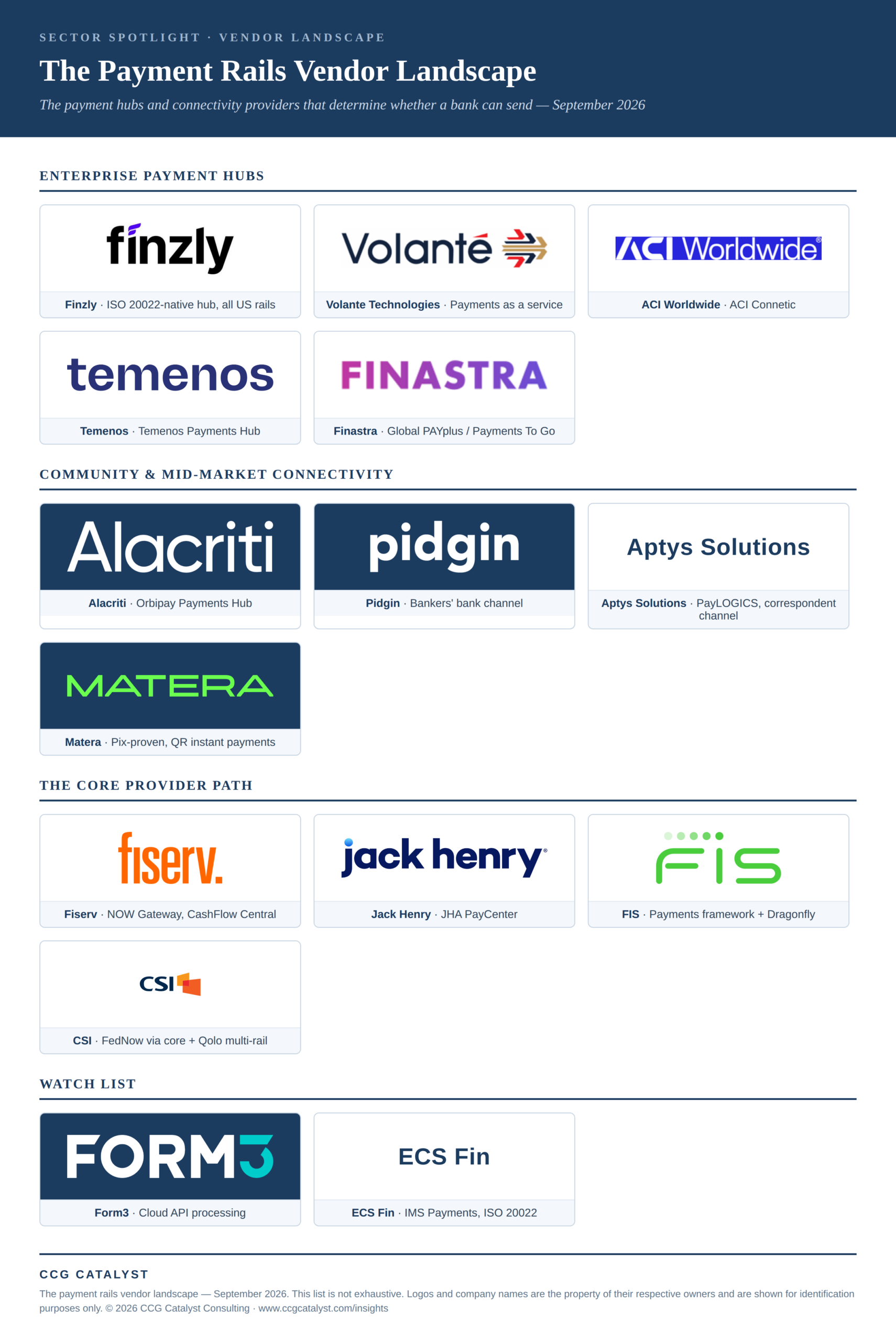
The payment rails vendor landscape – September 2026. Logos and company names are the property of their respective owners and are shown for identification purposes only. This list is not exhaustive and does not include all vendors in the space – if you are a vendor not featured here, please contact us so we can consider updates.
Finzly: Independent, Charlotte-based, and the momentum name in the category – named a market leader in the 2026 American Bankers Association product assessment of payment hubs, one of four so recognized, and a finalist for Best Back-Office/Core Services Solution at the 2026 Finovate Awards. The Finzly platform runs FedNow, RTP, Fedwire, ACH, and Swift ISO 20022-native on one system, sold directly to banks; Vantage Bank chose Finzly to modernize its payment operations, and an integration with Q2’s digital banking platform landed in August 2025 – meaningful because it connects the hub to the commercial channel the customer actually uses.
Website: www.finzly.com
Volante Technologies: Independent, New York-based, with Wells Fargo Strategic Capital among its investors – and a Leader in Gartner’s first Magic Quadrant for banking payment hub platforms. Payments-as-a-service across the US rails with named clients including SouthState Bank and ISO 20022 work for Citi; a next-generation ACH service went live in April 2025. The diligence note: the most recent named US client win is 2024 – ask for the current logo list.
Website: www.volantetech.com
ACI Worldwide: The public-company incumbent (NASDAQ: ACIW), consolidating its enterprise payments engine onto cloud-native ACI Connetic – built to reach eight US and international networks, six live today including FedNow and RTP, with ACH connectivity to follow – and with the Federal Home Loan Bank of Atlanta as a named Connetic win. The evaluation question is the classic incumbent one: the installed base is deep, and so is the difference between the legacy engine and the platform ACI wants to sell you.
Website: www.aciworldwide.com
Temenos: The Swiss public company’s SaaS payments hub is FedNow-certified with a strong US proof point in the enterprise tier: Commerce Bank live on FedNow through Temenos Payments Hub – “a top US bank,” in Temenos’s words – and the company took Best Back-Office/Core Services Solution at the 2026 Finovate Awards, announced this month. The consideration is the one that follows Temenos everywhere in the US market: the payments hub is strongest for institutions comfortable with a European-headquartered platform partner.
Website: www.temenos.com
Finastra: Vista Equity Partners-owned; Global PAYplus remains the payment engine inside many of the largest US banks, with Payments To Go as the mid-market SaaS version and a 2026 AI fraud-prevention partnership with FraudAverse. The ownership pattern to weigh: Finastra has been divesting non-payments businesses, and in September 2026 Reuters reported that Vista Equity Partners had called in bankers to explore a possible sale of the company – which cuts both ways. Payments is clearly the core of what a buyer would be acquiring, but any institution evaluating Finastra today should ask its diligence questions with a change of ownership on the table.
Website: www.finastra.com
Alacriti: Independent, New Jersey-based, with a May 2026 growth investment led by Sageview Capital joined by BMO Capital Partners and the credit union fund Curql – note who invested, because the Orbipay payments hub has built its franchise in credit unions, with named clients including Lighthouse Credit Union, Desert Financial, and Ascend Federal Credit Union. For commercial-bank buyers, ask for bank references specifically.
Website: www.alacriti.com
Pidgin: Independent, Atlanta-based, and the community institution’s most realistic on-ramp to sending: instant payments connectivity distributed through the correspondent and bankers' bank channel, where its partnership with United Bankers' Bank was named one of American Banker’s 2025 Innovations of the Year for bringing real-time payments to small banks. If your correspondent already offers it, the build-versus-buy question may already be answered.
Website: www.pidgin.net
Aptys Solutions: Private, Georgia-based; the PayLOGICS hub reaches thousands of institutions through correspondent and bankers' bank aggregators – PCBB began distributing Aptys’s ACH modules to community banks in 2018. Lower public profile than its peers; confirm the roadmap and ownership structure directly in diligence.
Website: www.aptyssolutions.com
Matera: The wildcard, and the one I would watch most closely. Built on Brazil’s Pix – which now handles more transactions than credit and debit cards combined in its home market, per central bank data – Matera took a $100 million investment from Warburg Pincus in July 2024 to fund its US expansion and was featured in the Federal Reserve’s own FedNow innovation spotlight in December 2025 for its instant QR-code payments work. The strategic read: the country that already ran the instant-payments experiment is now exporting the playbook.
Website: www.matera.com
For most community institutions the first conversation is with the core, and all three majors now offer genuine send capability: Fiserv through NOW Gateway, a single connection to both FedNow and RTP, complemented by CashFlow Central for small-business receivables and payables inside bank digital banking; Jack Henry through JHA PayCenter, with send and receive on both networks; and FIS, which pairs its payments framework with the corporate digital banking platform it acquired in the Dragonfly transaction.
CSI, privately held and the fourth name in most core conversations, belongs in this section too, and its story just changed. CSI has offered instant payments through the FedNow Service since July 2023, delivered through its NuPoint and Meridian core platforms with receive and account-to-account capability, Illinois-based INB, N.A. as the early adopter. What moves CSI up this list is the July 2026 acquisition of Qolo, a payments infrastructure platform whose money movement engine runs ACH, RTP, FedNow, wire, and push-to-card through a single integration. CSI says it will run Qolo as an orchestration layer across payments, accounts, and workflows for commercial banking which, executed well, takes the fourth core from a FedNow-receive story to a genuine multi-rail hub story, and brings RTP into a portfolio that previously spoke only FedNow in public. The diligence questions are timing questions: what is live on the sending side today, on which rails, and when the Qolo integration reaches your core release.
The evaluation question across all four is not whether your core can connect you, it is what origination costs per transaction, how fast your core version gets certified, and whether the fraud controls at the moment of send are yours to configure or theirs to ration. Integration gravity is real; so is the difference between a rail your core resells and a capability your bank owns.
Two names belong on the radar with flags attached. Form3 – London-based, with Visa, Mastercard, and Goldman Sachs Asset Management among its investors sells cloud-native API processing with US FedNow and RTP coverage, but has no publicly named US bank clients; the technology reputation is real, the US reference list is the diligence question. Website: www.form3.tech. ECS Fin. New York-based, ISO 20022-native processing with Swift connectivity is active but similarly unnamed in US trade press. Ask both the same question: who, exactly, is live?
If you are a buyer, start where “Three Rails, One Number” ended: the scarce capability is sending, and everything in the evaluation should serve it.
Send on day one: Demand the origination roadmap in writing - which rails, what limits, what controls - and reference-check a client who actually sends at your asset size. The 12-to-18-month receive-to-send lag in the industry data is mostly project sequencing; a vendor who has done it before compresses it.
Request for Payment on the roadmap: The least-built, most-demanded layer of the stack is electronic invoicing across the instant rails. Ask when the vendor ships it, and what it costs. A hub without a Request for Payment plan is selling you the last war.
ISO 20022 as a product, not a compliance line: The structured remittance data now travels with every payment. Ask how the platform surfaces it to your commercial customers – cash application, reconciliation files, reporting – because that data is where the fee income moved.
Intelligent routing that serves the customer, not the vendor: In our April research, 75% of executives rated payment routing as critical – the hub should choose the cheapest adequate rail for each payment automatically, by rules you control. Ask who sets the routing logic, whether it optimizes your economics or the vendor’s, and how it will accommodate rails that do not exist yet – because the tokenized-settlement networks arriving in 2027 will be one more routing destination, not a new project.
Fraud at the moment of send: Instant means irrevocable. The hub must screen at origination – account validation, behavioral scoring, limits by customer and channel – and integrate with your fraud stack, not replace it. With 76% of organizations hit by payments fraud last year, the fraud conversation is the sales conversation.
Ownership and roadmap: The pattern from every Spotlight repeats – ACI and Temenos answer to public markets, Finastra to Vista’s portfolio math – with a possible sale reportedly in exploration as this Spotlight went to press – Finzly, Volante, Pidgin, and Alacriti to private investors with their own horizons, Matera to Warburg Pincus. Ask who owns the roadmap and what the exit horizon implies for the product you are buying.
Pricing against a zero-fee rail: The Fed made FedNow participation free for 2026 and origination nearly so. Model the hub’s per-transaction economics honestly at your volumes – the rail is cheap; make sure the software layer above it does not quietly rebuild the wire’s margin for somebody else.
Data rights and exit: Payment histories are commercial relationship data. Demand unrestricted extraction, standard formats, and capped deconversion fees before you sign – your payments data will outlive your vendor relationship.
For expert guidance on selecting and implementing these solutions, consider consulting with firms like CCG Catalyst, who specialize in navigating the financial services ecosystem to match your unique requirements.
Read yesterday’s companion commentary, “Three Rails, One Number,” at CCG Insights, along with the related Spotlights this update builds on: Payment Hubs (March 2025), Real-Time Payments (May 2025), and Business Banking Platforms (May 2025). Reach our team at www.ccgcatalyst.com.
By: Paul Schaus | Founder & Managing Partner, CCG Catalyst Consulting
CCG Catalyst’s Sector Spotlights highlight third-party solutions, products, and the companies that offer them. They provide a snapshot of the innovations, trends, and key players in the financial services ecosystem.