

Yesterday’s commentary, “Digital Banking Today: Three Fronts, Four Tiers,” ended with a warning: if you are a community institution, your digital ceiling is set by your vendor before your strategy is even written. This Spotlight names the vendors. The market they compete in is remarkably concentrated at the top - FI Navigator’s 2026 analysis of US bank mobile banking found the top four vendors holding 71% of installations and the top ten holding 92.8% and remarkably busy underneath, with more ownership change in the last twenty-four months than in the previous five years. We apply the same discipline as every Spotlight: confirm every vendor is active, verify who owns them today, note who they serve - banks, credit unions, or both - and name only the clients we can substantiate.
A digital banking platform is the software your customers believe is the bank: the mobile app and online experience where they check balances, move money, deposit checks, open accounts, and on the commercial side, originate ACH, approve wires, and manage positive pay. It sits on top of the core system, and the central strategic question of this market is how tightly those two layers are tied. For decades the answer was “completely” and you bought digital from your core because integration made anything else impractical. That answer is coming apart in both directions at once: independent platforms now implement across cores as a matter of routine, while the acquisitions reshaping this market keep pulling digital back toward larger platforms. Which force wins at your institution is a purchase decision, and this Spotlight is built to inform it.
Four developments define the current landscape. First, consolidation, and note the pattern in who is buying. Alkami acquired MANTL, the account opening specialist, for roughly $400 million in early 2025. CSI, the core provider, acquired Apiture, the largest bank-focused independent digital platform, in a deal announced August 2025 and followed it with Qolo, the payments infrastructure platform, in July 2026. FIS acquired Dragonfly Financial Technologies, the corporate digital banking business, and rebuilt Digital One Commercial around it, then reached past digital entirely and bought OpenCoreOS, an AI-native core banking startup, months after its January 2026 launch, installing its founder as president of enterprise platforms. Look at the buyers' business cards: with the exception of Alkami, they are core processors, and they are buying at every layer of the stack. That is not a coincidence, and it is a thread we will pull hard in our core processing coverage later this month.
Second, the largest carve-out in the category’s history is now a standalone company: Veritas Capital completed its $2.45 billion acquisition of NCR Voyix’s digital banking business in September 2024 and rebranded it Candescent, instantly creating the biggest core-independent player by client count. Third, capital kept arriving: Lumin Digital raised $115 million in July 2026 at a $1.6 billion valuation, with more than $70 million of it coming from its own bank and credit union clients, a client-investor model no one else in this market runs. Fourth, the exits: ACI Worldwide sold its corporate digital banking business years ago and is out of this category; Finastra sold its US mid-market business - the Phoenix core, Malauzai digital banking, and Fusion Analytics - to CORA Group, part of Jonas Software under Constellation Software, in June 2026, while its owner reportedly explores a sale of what remains - if your institution runs Malauzai, your digital banking vendor changed this summer whether you noticed or not; and SoFi’s Technisys-Galileo technology unit is not selling digital banking to US banks and credit unions. A landscape that looks crowded on a conference floor is, on verified evidence, considerably shorter.
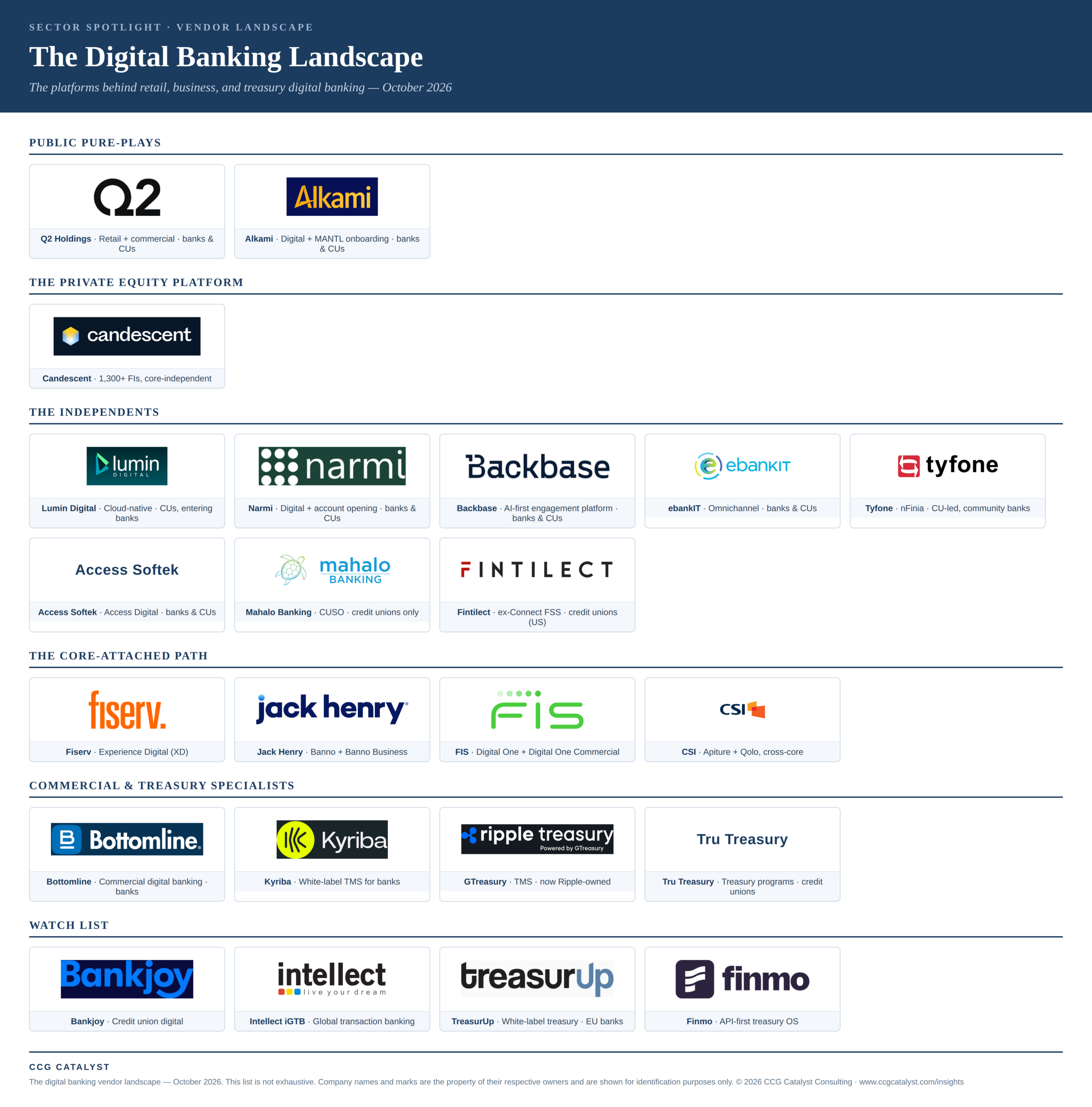
The digital banking vendor landscape - October 2026. Company names and marks are the property of their respective owners and are shown for identification purposes only.
This list is not exhaustive and does not include all vendors in the space - if you are a vendor not featured here, please contact us so we can consider updates.
Q2 Holdings - Austin-based, serves banks and credit unions, and the analyst consensus leader: Datos Insights named Q2 the market leader in US digital small business banking in 2025 and in US retail digital banking in 2026. The business is at an inflection: fiscal 2025 revenue of $794.8 million, up 14%, with the company’s first meaningful GAAP profitability and roughly $2.7 billion in committed backlog. Q2’s clearest differentiator among the pure-plays is commercial depth and it is the independent winning Tier 1 commercial and treasury deals, which matters if yesterday’s business-front argument landed with your board. The diligence note: recent wins are disclosed by tier, not by name; ask for the current logo list at your asset size.
Website: www.q2.com
Alkami - Plano-based, historically credit-union-heavy and now demonstrably converting banks: 37 new digital banking logos in the trailing twelve months, 15 of them banks, with annual recurring revenue of $511.7 million, up 21%. The strategic move was the MANTL acquisition, which bolted the account opening front door onto the digital platform and it is producing: MANTL clients raised more than $3 billion in deposits from existing relationships in six months. Named 2026 wins include Amplify Credit Union and Rhinebeck Bank on the MANTL side. Not yet GAAP profitable; the evaluation question is platform-plus-onboarding as one contract versus best-of-breed as two.
Website: www.alkami.com
Candescent - the former NCR Voyix digital banking business, owned by Veritas Capital, serving more than 1,300 banks and credit unions, the largest core-independent installed base in the market. The past year brought a new chief executive, Jason Edelboim, in June 2026 and a product push around next-generation mobile (Votiv) and a developer suite (Forge). The questions for diligence is the private-equity questions: Veritas bought this business to exit it eventually, so ask about roadmap investment by product line, and reference-check clients your size on the platform version you would actually run.
Website: www.candescent.com
Lumin Digital - cloud-native, credit-union-centric and moving into banks, and the momentum story among the independents: $115 million raised in July 2026 at a $1.6 billion valuation, more than $330 million cumulatively, with fifteen of its own client institutions among the investors. Named wins include Commonwealth Credit Union. Clients who buy equity in their vendor are making a statement about switching intent; ask what governance rights they got, because alignment is only as good as its mechanics.
Website: www.lumindigital.com
Narmi - New York-based, serves banks and credit unions, and the speed play: consumer and business digital banking plus account opening, implemented across multiple cores, with eleven institutions taken live in the third quarter of 2025 alone, including Grasshopper Bank. The 2026 wins keep coming, Northrim Bank, a $3 billion Alaska institution, and CTBC Bank USA among them. Narmi’s last disclosed raise is older, from 2022; ask about capitalization and runway directly.
Website: www.narmi.com
Backbase - Amsterdam-headquartered, founder-led, serving banks and credit unions at the larger end of the community market and above; relaunched its platform in 2025 around an AI-first architecture, and holds the strongest recent US credit union win among the internationals: Alliant Credit Union, one of the largest in the country. The consideration is the one that follows every European platform vendor here: US client density and US-based support, so ask for domestic references specifically.
Website: www.backbase.com
ebankIT - Porto-headquartered omnichannel platform with a North American office in Atlanta and, at last, a genuine US reference: Metropolitan Commercial Bank, the New York City commercial bank, launched its consumer digital banking platform on ebankIT, with business and commercial accounts planned as the next phase. The rest of the named roster runs Canadian and international, so MCB is the domestic reference call to make.
Website: www.ebankit.com
Tyfone - Portland-based, credit-union-led with community banks in the mix; the nFinia platform posted a steady run of named wins including iTHINK Financial in March 2026 and Gold Coast Federal Credit Union.
Website: www.tyfone.com
Access Softek - privately held, serving banks and credit unions, with Arkansas Best Federal Credit Union a named January 2026 win; a long-tenured platform with a lower public profile than its peers, so build the reference list carefully.
Website: www.accesssoftek.com
Mahalo Banking - Troy, Michigan; credit unions only, and credit-union-owned - it is a CUSO, which changes the ownership conversation entirely. Known for neurodiverse-accessible design; recent activity runs to renewals and upgrades rather than splashy logos, which is its own kind of evidence.
Website: www.mahalobanking.com
Fintilect - the former Connect FSS, merged with the UK’s ieDigital and the AI firm ABAKA under Parabellum Investments; serves credit unions on the US side. A three-way merger under a family office is a genuinely unusual structure in this market - ask which product roadmap survived the combination.
Website: www.fintilect.com
For most community institutions the first digital conversation is with the core - and the first thing to understand about that conversation is that each core vendor sells one digital story while operating an estate of platforms: a current flagship, the legacy products much of the installed base still runs, and the acquisitions in between. Vendor by vendor:
Fiserv (NYSE: FI) - the flagship is Experience Digital (XD), bundling digital banking with Cash Flow Central for small-business payments and, as of June 2026, embedded AI personalization from Personetics; Fiserv holds first position in US bank mobile banking installations. Beneath XD sits the widest estate of the majors: Retail Online and Business Online - the “ROB” and “BOB” many Premier banks still run - Architect, the Signature/DNA-era platform still widely installed, and Commercial Center, the treasury and business banking portal actively marketed in Corporate and Small Business editions beside XD rather than inside it. We regularly walk into community banks running three of these at once.
Jack Henry (NASDAQ: JKHY) - Banno and Banno Business are the flagships, closing the installation gap with Fiserv and holding a top ranking in small-business digital banking. The estate is consolidating by force of policy: NetTeller, the long-serving online banking product, is being formally retired with a documented migration path to Banno - so a NetTeller bank is not deciding whether to convert, only when and on whose terms, which is negotiating leverage if used before the deadline uses you.
FIS (NYSE: FIS) - Digital One is a family, not a product. Digital One Flex is the retail and small-business edition most community banks actually run; Digital One Commercial - the rebuilt, acquired Dragonfly corporate platform - is a different product with a different roadmap at the top of the market; credit unions are served through the AffinityEdge core lineage. Ask which edition is being quoted, because the capabilities and the release calendar are not the same.
CSI - the one behaving differently, and deliberately. In fourteen months it acquired Apiture - the strongest bank-focused digital platform in the community market, with CSI stating it remains available regardless of core - and Qolo, the multi-rail payments engine, explicitly pitching both across other vendors' cores. But the estate rule applies here too: the installed base today still overwhelmingly runs CSI's own in-house digital banking, and the Apiture conversion wave is ahead of that base, not behind it. The diligence is which platform your renewal actually quotes, on what migration timetable, and at whose cost - and we return to the strategy behind these acquisitions in our October core processing coverage.
Two conclusions cut across all four. First, be clear-eyed about what you are evaluating: core-attached digital is generally not a best-of-breed solution, it is a competitive one - and for many institutions competitive is enough. What separates the contenders from the compromises is provenance (built, like Banno, versus bought, like Dragonfly and Apiture), how deeply the acquired pieces are integrated rather than co-branded, and the vendor's business foundation: a core processor's digital product exists, first, to defend the core relationship, and its investment priorities will follow that logic, not yours. Second, the estate is the contract question: you are never buying “the” digital product, you are buying a position in a portfolio of current, legacy, and acquired platforms - so pin down which one, exactly, is in your agreement, how long the vendor will invest in it, and who pays for the move when the answer changes.
Which leaves the question every buyer should ask directly: are these platforms core-dependent? On paper, less than they used to be - Jack Henry's platform documentation says it is working toward integration with third-party cores alongside its four foundational cores, FIS markets Digital One across cores, and CSI states Apiture remains available regardless of core. In the public record, though, a named win at an institution running a competitor's core is essentially absent for all three majors. So put the claim to the test: ask for a reference institution running the digital platform on someone else's core. If the vendor cannot produce one, core-agnostic is a roadmap, not a track record.
If the treasury and cash management front from yesterday’s commentary is where your 2027 investment goes, think of this market as two layers: the portal your corporate clients log into, and the white-label treasury capability behind it.
The portal layer is short. Bottomline - Portsmouth, New Hampshire, owned by Thoma Bravo remains the flagship independent commercial digital banking platform, actively shipping fraud and payments capability into its portal; its recent public news is product rather than named US bank wins, so ask for the current client list.
Website: www.bottomline.com. Q2 is the pure-play winning large commercial deals, per its own disclosures. FIS Digital One Commercial carries the Dragonfly corporate banking heritage, the closest descendant of the old ACI corporate banking unit, and worth naming as such because many treasury desks still run its lineage. And the broader cash management portals from the core majors are, whatever they are called, what most corporate clients log into. The exits matter as much as the entrants: ACI left this business, and Finastra whose Corporate Channels portal once anchored many large-bank treasury desks and remains with the company after the CORA Group sale noted above has an owner reportedly weighing a sale of what is left, which means any evaluation of Finastra digital assets should assume a change of ownership mid-contract is possible.
Our team at CCG Catalyst maps who buys what:
| Commercial and cash management stack | The typical buyer |
|---|---|
| FIS Digital One Commercial (Dragonfly lineage) | Regionals that want a mid-market and corporate cash management stack without building it - the “next 100” banks competing with the money centers |
| Fiserv commercial and cash management modules | Regionals already on a Fiserv core - the path of least resistance, which is not the same as the best path |
| Jack Henry Banno Business and Treasury Management | Community banks and smaller regionals on Jack Henry cores |
| Q2 commercial and treasury | The modern-experience choice when the institution is not locked to a core-attached path |
| Bottomline | Institutions buying a dedicated commercial digital banking platform rather than a module |
| Backbase | Regionals rebuilding the front end, often paired with someone else’s payments and cash engine |
| Candescent, CSI/Apiture, Alkami | Community-to-regional institutions buying business banking as part of a broader digital platform |
| Infosys Finacle, Intellect iGTB | Institutions with international or larger corporate ambitions - subject to the watch-list question below |
The white-label layer is how a bank offers corporate clients treasury-management-system capability - cash positioning, forecasting, payments, connectivity, without building it. Kyriba, named the world’s best treasury management system by Euromoney in 2025, runs an explicit white-label program for banks that packages its modules under the bank’s brand. GTreasury deserves a hard look for a reason that has nothing to do with features: Ripple acquired it for $1 billion and relaunched the platform in January 2026 as the first treasury management system with native digital-asset capability, a forty-year-old TMS with bank distribution now belongs to a crypto infrastructure company, which is either the future of corporate treasury or a diligence flag depending on your institution’s digital asset posture, and readers of our CLARITY Act commentary will recognize the pattern of crypto firms buying their way into bank channels. On the credit union side, Tru Treasury, named CUSO of the Year at the 2025 NACUSO conference, builds and runs treasury management programs for credit unions moving into business services, the charter-specific answer to a capability most credit unions cannot justify building alone. Two more names sit on the watch list with the usual question: TreasurUp, the Dutch white-label treasury front-end, names Nordea, Rabobank, and KBC among its banks but no US institutions yet, and Finmo, the API-first treasury operating system courting financial institution partners, has thin public US evidence. For both: who, exactly, is live here?
In our advisory work, the decision on this front usually runs in a sequence at regional scale, community banks have a shorter path, covered in the next section and knowing where you are in it saves a year of evaluation:
Stay with the core vendor’s commercial offering until your commercial clients tell you the portal is dated, which they will do with their feet before they do it in a survey. One important exception: if commercial banking is the strategy, do not wait for the complaint. A strategy-led institution starts this evaluation from its growth plan, not from attrition data, because by the time the deposits leave, the decision has been made for you.
Switch the digital layer to a pure-play like Q2 or Alkami when SMB growth is the strategy and the core vendor digital experience is the obstacle.
Add dedicated cash management specialist when you are hunting $20 million to $500 million revenue companies and losing deals on entitlements, reporting, and payment controls, the plumbing, not the interface. And yes, Digital One Commercial is genuinely core-agnostic: it is architected as a layer that sits above existing transaction engines and connects through APIs, a credible claim given the Dragonfly lineage sold to banks on every core for years though core-agnostic is not implementation-free, and the entitlement and payment-engine integration against your particular core is where the project time goes.
White-label a treasury management system like Kyriba or GTreasury only for the handful of sophisticated treasuries at the top of your book - it is a targeted weapon, not a platform for the whole business portfolio.
Everything above scales down, but not linearly, and for community institutions the honest starting point is the core pairing, because that is how this market actually clears:
| If your core is | The digital and business banking you usually buy |
|---|---|
| Jack Henry (SilverLake, CIF 20/20, Core Director) | Banno and Banno Business, with Jack Henry Treasury Management on top |
| Fiserv (DNA, Premier, Precision, Cleartouch) | Fiserv digital plus its cash management modules - see the CoreAdvance note below |
| FIS (HORIZON, IBS, Profile) | FIS digital and Digital One, in its lighter commercial tier |
| Independent or other (CSI, COCC, and peers) | Q2, Alkami, Narmi, Apiture, or Candescent |
Q2 and Alkami are the two names that show up most when a community bank leaves the core vendor’s digital product; Narmi and Apiture win when price and speed to live matter more than commercial depth with Apiture’s new CSI ownership now part of that calculus.
One roadmap note for the Fiserv row, because it changes the question. Fiserv is consolidating its community bank cores into CoreAdvance, a modern platform built on Premier as the foundation with the best of Cleartouch and Precision folded in and DNA is not part of that consolidation. That splits Fiserv-core banks into two camps: Premier, Precision, and Cleartouch institutions should be asking what the CoreAdvance migration path means for their digital and cash management stack, because digital decisions ride on core release schedules; DNA institutions should be asking the opposite question, where DNA sits in a strategy now organized around a platform it is not part of. Either answer belongs in writing before your next digital commitment, and the core consolidation story behind it is exactly where our coverage goes later this month.
Be equally honest about what your business customers need. The local shops, contractors, medical practices, and small property managers who make up a community bank’s business book need multi-user login with dual control, ACH for payroll and vendors, low-volume wires, bill pay, positive pay and ACH filters, remote deposit, sync with QuickBooks, Xero, or Sage, and simple reporting and entitlements. They do not need payment factories, in-house banks, multi-bank treasury systems, or ISO 20022 corporate suites. Buy for the client you have, not the client in the vendor’s demo. The add-on stack is similarly predictable: fraud monitoring is very commonly Verafin or the core vendor’s suite, remote deposit and lockbox come from the core vendor or Jack Henry’s treasury and payments add-ons (the former ProfitStars line), cards run through the core vendor, Visa DPS, or - on the credit union side - Velera (the former PSCU and CO-OP), and business account opening is often Q2, nCino, or a lightweight specialist which is precisely next week’s topic. And the white-label treasury systems from the previous section are rare at true community banks: an $800 million bank with three commercial relationship managers does not buy a Kyriba.
How community banks choose, in our experience, comes down to four rules:
Stay on the core vendor unless the business portal is losing deposits - switching digital is a 12-to-18-month project, and the decision should be priced that way.
If you switch, pick one platform across consumer and SMB - that is where Q2 and Alkami earn their market share.
The treasury module comes from the same vendor you just chose, not from a second enterprise system.
Price and implementation staffing matter more than feature checklists, a community bank has one or two IT people and maybe one payments specialist, so the vendor’s implementation team is effectively your project staff, and you should evaluate it like one.
The practical shortlist by situation: on a Jack Henry core and happy enough with the experience, Banno Business plus Jack Henry Treasury; on a Fiserv core, stay on Fiserv digital unless commercial clients are leaving; want one modern platform and willing to pay for it, Q2 or Alkami; smaller, faster, cheaper, Narmi or Apiture; strong commercial ambition, unusual at community scale - look at FIS Digital One Commercial only after the core digital is settled.
Two names, with the same question for each: who, exactly, is live? Bankjoy, the Detroit credit-union platform. Intellect Design’s iGTB, the Indian transaction-banking suite, is a global seller with no verified 2025-26 named US wins. None of these means the platforms are not selling; it means the burden of proof in diligence sits with the vendor.
If you are a buyer, start where yesterday’s commentary ended: pick the front you intend to win, then evaluate every vendor against that front specifically.
Serves your charter, at your size: The single most common selection error we see is evaluating a platform on features before confirming it serves institutions like yours. Every vendor above is marked by who they serve - banks, credit unions, or both - because a credit-union-tuned platform’s business banking gaps, and a bank platform’s member-experience gaps, surface after conversion, not before.
Business banking depth, not a business banking checkbox: Yesterday’s number - 47% of banks under $100 billion offer digital onboarding to small businesses against 72% for retail - is a vendor capability gap as much as a bank strategy gap. Demand a demonstration of the actual SMB workflows: entity onboarding, ACH origination limits, user entitlements, positive pay. A retail platform with a business skin will show you the gaps in the demo if you ask for them.
Account opening: built in, bolted on, or missing: Alkami paid $400 million for MANTL because the front door is where the growth is. Ask every digital vendor what their account opening is - native, partnered, or a referral - and hold that answer for next week, when we cover account opening as its own market, because it is one.
Core integration reality, not core integration claims: “Core-agnostic” is a slide; certified, in-production integrations at named institutions on your core and your release are evidence. Ask for both and ask what the core’s integration fees add to the vendor’s price, because the cheapest platform on paper can be the most expensive one behind your particular core.
Ownership and horizon: This roster spans public companies (Q2, Alkami, the three core majors), private equity holdings (Candescent under Veritas, Bottomline under Thoma Bravo), founder- and family-office-owned platforms (Backbase, Fintilect), client-owned structures (Mahalo, Lumin’s client-investors), and businesses in motion (Finastra). Every one of those structures has a different answer to “who owns the roadmap and when do they need to exit?” Get that answer in the room.
AI on the roadmap with receipts: Every vendor in this market now says AI. Personetics inside Fiserv XD, Backbase’s platform relaunch, and Candescent’s intelligent-banking push are real investments; the diligence question is which capabilities are in production at reference clients versus in the demo environment. Ask to speak to an institution using the AI features, not just the platform.
Data rights and exit: Your digital banking data - behavioral, transactional, relationship is the raw material of everything the industry wants to do next. Demand unrestricted extraction in standard formats and capped deconversion fees before you sign. In a market consolidating this fast, assume your vendor’s owner will change before your contract ends, and write the contract for that.
For expert guidance on selecting and implementing these solutions, consider consulting with firms like CCG Catalyst, who specialize in navigating the financial services ecosystem to match your unique requirements.
Read yesterday’s companion commentary, “Digital Banking Today: Three Fronts, Four Tiers,” at CCG Insights. Next week the series turns to the front door: a commentary on the state of online account opening, followed by a Spotlight on the account opening vendor landscape. Reach our team at www.ccgcatalyst.com.
By: Paul Schaus | Founder & Managing Partner, CCG Catalyst Consulting
CCG Catalyst’s Sector Spotlights highlight third-party solutions, products, and the companies that offer them. They provide a snapshot of the innovations, trends, and key players in the financial services ecosystem.