


Three weeks ago, this series opened with a bank CEO whose answer to “how is digital going” was the mobile app, and I called that answer a generation out of date. Today, in the final piece, I will tell you what replaces it and it is not a bigger app, and it is not an autonomous AI bank. The next digital banking experience is a trusted task layer over banking services: the customer states what they need done, across any channel, and the institution’s systems understand it, check whether it is permitted, execute it deterministically, and can prove afterward exactly what happened and why. The dashboard your customers log into today does not disappear, it becomes the evidence surface, where balances, transactions, controls, and status live. The work moves above it. Everything this series has covered - the three fronts, vendor consolidation, dying application form - converges on this architecture, and the institutions that understand it will make better buying decisions for the next decade than the ones still asking which app looks best in the demo.
Describe the destination concretely, by segment. A consumer in 2030 expects help understanding their cash, controlling a card, paying a bill, reporting a suspected scam, delegating a narrowly scoped task, and - critically - reaching a human who can resolve a problem. A small business expects invoice-to-cash, payables, approvals, and accounting synchronization connected to its banking relationship, not adjacent to it. A treasurer expects cash position, forecasting, and bounded approvals to appear inside the ERP or treasury workflow where the work already happens. Notice what is common: in every segment the customer is delegating tasks and demanding proof, and in every segment the interface is wherever the customer already is - which is the thread that ties this piece to everything before it in the series, from the business front to embedded account opening.
And note what this future is not: digital-only. The FDIC’s national household survey found mobile is the primary channel for 48.3% of banked households - and that almost all banked households still used a teller or ATM at least once, with teller use more prevalent among several customer groups. The task layer must carry the same task, the same status, and the same case across mobile, web, contact center, and branch. The measure of success shifts accordingly: completed financial outcomes and successful recovery when something goes wrong - not sessions, not app engagement, not the metrics the industry has congratulated itself on for a decade.
This is not futurism; the bounded version is shipping at the largest banks, and the pattern is instructive. U.S. Bank’s small business platform puts invoice automation, approvals, accounting sync, and payment status inside online banking - built on Fiserv’s CashFlow Central with Melio, which is workflow composition on top of existing systems, not a merged ledger. The same bank’s Liquidity Manager delivers forecasting, cash position, and multi-bank pooling with Kyriba - the white-label treasury layer from our October 7 Spotlight, arrived exactly where we said that market was going. And Bank of America’s Erica, the industry’s most-used assistant, is deliberately bounded: authenticated, built on predefined responses rather than generative AI, and able to hand off to a specialist. The institutions that are the furthest ahead are not the ones giving AI the most freedom. They are the ones giving it the clearest boundaries.
The question underneath this whole series - asked every time a core vendor bought a digital platform in our Sector Spotlights - is whether core processing and digital banking merge into one stack. The careful answer is they converge, but under control, and the industry keeps confusing five different things when it says “convergence.” Commercial consolidation (one vendor owns both - demonstrably happening); a unified customer journey (one smooth workflow - achievable today); shared services for identity, data, and controls; integrated deployment; and a literal technical merger into one system of record. The first four advances independently of the fifth, and the Kansas City Fed’s core modernization research identifies full replacement, component replacement, and wrapping as equally credible paths - which argues against treating a one-stack future as inevitable.
Here is the frame I will carry into next week’s core processing coverage, so consider the thesis stated in advance. What should converge first is the control plane: who the customer is, what they consented to, who may act in what role, what the product rules are, what the fraud decision was, where the case stands, and what the audit trail shows. What should remain explicitly separate - whoever sells it to you, however it is bundled - is authoritative state: ledger, payment finality, reconciliation, and legal record. A vendor can offer both in one suite. Your institution must still be able to say which system owns which truth, and what happens when they disagree.
Our team at CCG Catalyst summarizes the target architecture - the frame we now use in digital strategy engagements:
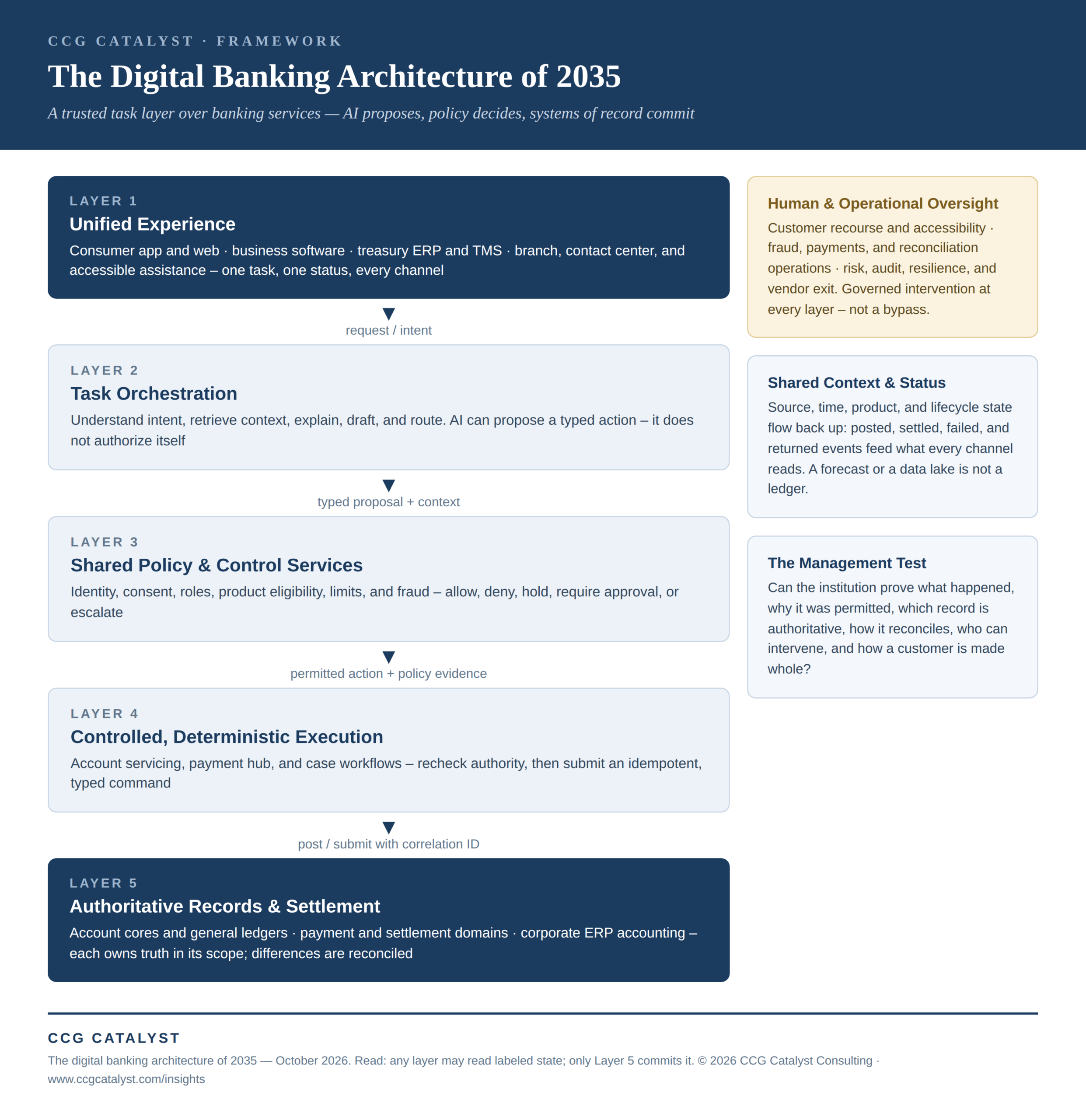
The digital banking architecture of 2035 - CCG Catalyst framework, October 2026.
The load-bearing idea is the separation of read, decision, and execution. An experience surface or an AI model may read labeled state, explain it, and prepare a typed request - but a deterministic policy service decides whether the actor, role, account, limit, and fraud context permit it, and only a system of action executes it, with only the ledger or rail committing authoritative state. AI proposes; policy decides; systems of record commit. This is not caution for its own sake: prompt injection, excessive autonomy, and approval manipulation are recognized risks of agentic systems, and the discipline holds against all of them because the model never holds the pen. Three confusions this architecture refuses, each of which I have watched sink a project: authentication is not authorization - a passkey proves who you are, not that you may release a business payment; a data lake is not a ledger - a forecast surface must never be mistaken for accounting truth; and an instant rail does not eliminate exceptions - Regulation E’s error-resolution duties exist precisely because things go wrong, and a delegated or AI-assisted action must always leave consent evidence, decision reasons, a case owner, and a path for the customer to stop, contest, and recover.
Read the vendor market of the past three weeks through this frame and the strategies become legible. The contest is not for the front end - it is for configuration, workflow context, and trusted control points. The core incumbents extend suites toward the whole stack; the digital pure-plays climb toward orchestration; the ERP and accounting platforms pull banking tasks into their workflow context; and the identity, fraud, and AI vendors from last week’s Sector Spotlight are competing to own Layer 3, the policy and control services - which is why their valuations look the way they do. Two consequences for buyers. First, accountability does not move: interagency guidance is explicit that using third parties does not diminish the institution’s own responsibility - you can rent every layer and you still own the outcome. Second, procurement language must mature: demand authoritative-state semantics, entitlement evidence, reconciliation and recovery behavior, visibility into critical subcontractors, and export and transition support in writing - because “composable” without those properties is not flexibility, it is a hidden critical path.
Our team at CCG Catalyst sequences the decade this way - analytical expectations, not predictions with dates attached:
| Horizon | What leading institutions do |
|---|---|
| 2026-2028 | Build the foundations: source-of-truth inventories, shared customer and consent records, authoritative status events, case management, payment and fraud operations, tested vendor exit. Migrate only contained domains, with parallel reconciliation. |
| 2029-2031 | Consolidate reusable product, decision, and case services across cores and channels; distribute controlled tasks into ERP, accounting, and conversational surfaces. |
| 2032-2035 | Operate a contextual policy layer across multiple ledgers and rails; adopt tokenized-deposit and embedded workflows where the economics are proven, not fashionable. |
My final comment: this series began with a scoreboard - three fronts, four tiers, a widening gap - and it ends with a management test, because that is the arc of the next decade. The winning institution of 2035 will not be the one with the most beautiful app or the most autonomous AI. It will be the one that can prove what happened, why it was permitted, which record is authoritative, how it reconciles, who can intervene, and how a customer is made whole - and can do all of that while the task takes seconds instead of days. Trust, demonstrated on demand, is the product. Everything else is packaging. Next week we take this frame to the layer underneath everything: a commentary on the core processing wars, and a Sector Spotlight on the core vendor landscape.
CCG Catalyst advises banks, credit unions, and fintech companies on digital strategy, vendor selection, and contract negotiation. If your institution is planning its next decade, reach out to our team at www.ccgcatalyst.com.
See our latest announcement: CCG Catalyst’s Paul Schaus Named a 2026 Top Consultant by Consulting Magazine
By: Paul Schaus | Founder & Managing Partner, CCG Catalyst Consulting
Disclaimer: The views expressed in this article represent the perspective of CCG Catalyst Consulting based on our direct experience advising financial institutions. This commentary is intended to stimulate industry discussion and does not constitute legal, accounting, or regulatory advice.