What the 2026 ABA Washington Summit means for community and regional banks
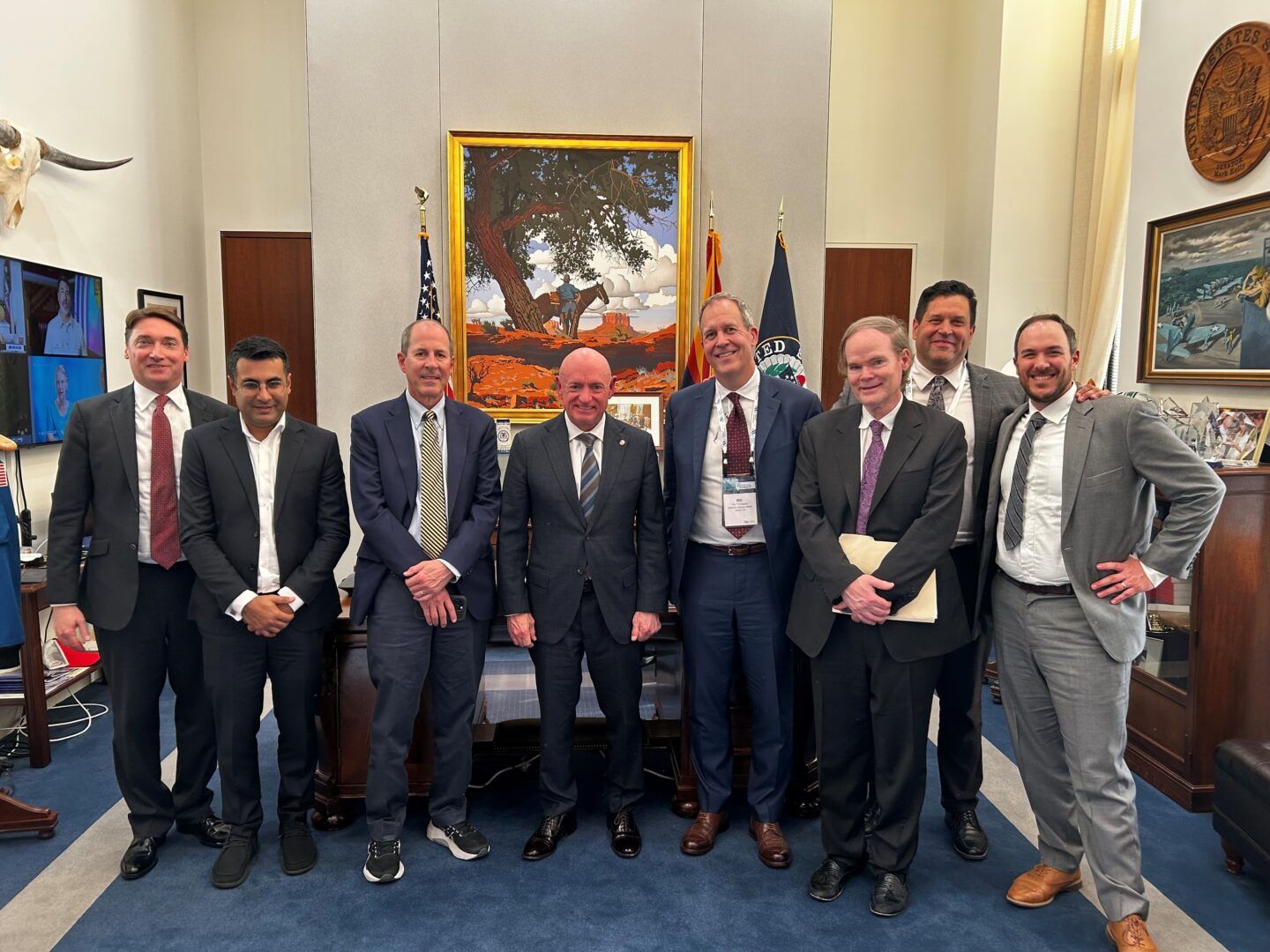
The Arizona delegation meets with Senator Mark Kelly during the 2026 ABA Washington Summit.
Last week I was in Washington for the 2026 ABA Washington Summit, joining more than 1,400 bank leaders for three days of regulatory sessions and legislative advocacy. I attended as part of the Arizona delegation organized by Paul Hickman, President and CEO of the Arizona Bankers Association, alongside executives from Western Alliance Bank, and BOK Financial,. Our delegation met directly with Senator Mark Kelly, staff for Senator Gallego, and staff for Representatives Ciscomani, Stanton, and Hamadeh, carrying the ABA’s legislative priorities on deposit insurance modernization, stablecoin regulation, fraud prevention, indexing regulatory thresholds, and credit card rate cap opposition.
That advocacy context matters because the regulatory sessions that preceded our Hill visits delivered something unexpected: genuine, coordinated alignment among the three primary banking regulators. Hearing from Federal Reserve Vice Chair for Supervision Miki Bowman, FDIC Chairman Travis Hill, and Comptroller of the Currency Jonathan Gould back-to-back made clear that this is a policy pivot with concrete implications for community and regional banks.
The Supervisory Pivot to Material Financial Risk
Every regulator used some version of the same phrase: material financial risk. The era of process-driven, check-the-box supervision is being actively dismantled.
FDIC Chairman Hill stated that the result of the agency’s reforms is supervision focused on what he described as the things that truly matter. The FDIC has updated examiner instructions accordingly, reduced consumer compliance exam frequency for small banks, eliminated disparate impact analysis in fair lending, and limited supervisory criticisms to actual legal violations.
Comptroller Gould rattled off a dozen concrete actions in seven and a half months: a community bank-focused supervision group, revised BSA/AML procedures, a simplified CRA strategic plan, amended model risk management guidance, reduced assessments, and more. He went further on MRAs, noting that a direct conversation with bank management is often sufficient and that formal enforcement actions should not be the default.
Bowman reinforced the same themes, emphasizing town halls with examiners and bankers to ensure the philosophy translates into practice. The coordination is deliberate and, if sustained, will materially reduce supervisory burden on well-run institutions.
Capital Reform Is Finally Happening
Bowman confirmed the Federal Reserve will finalize its Basel III capital proposals before the end of March. The new approach adopts a single-stack framework, removes the gold plating from mortgage and retail lending risk weights, and scales back punitive elements of the operational and market risk frameworks. A second component improves risk sensitivity for all banks with a focus on residential mortgage, consumer, and corporate lending.
The practical significance is substantial. The capital treatment of mortgage servicing assets has pushed origination and servicing into non-bank hands for years. Bowman addressed this directly, noting that the proposal aims to remove disincentives that have reduced banks’ role in relationship-based mortgage lending. For community banks, this is a strategic reopening of a business line that adverse regulation effectively closed.
Stablecoins Get Real
Chairman Hill delivered the Summit’s most consequential announcement: the FDIC plans to propose that payment stablecoins are not eligible for pass-through deposit insurance. His reasoning was grounded in the GENIUS Act’s explicit prohibition on representing stablecoins as federally insured. Hill wants this settled by regulation rather than discovered in a bank failure.
The OCC, meanwhile, published its own GENIUS Act regulatory framework and Comptroller Gould made an unusually direct appeal for industry comment, emphasizing this is not a process where the outcome is predetermined.
This was directly relevant to our Hill meetings. The ABA’s legislative priorities include closing the stablecoin interest loophole to preserve deposit stability. ABA Chair Kenneth Kelly urged attendees to educate their emerging leaders on how this loophole could undermine traditional lending. As CCG Catalyst detailed in our recent New Frontier In Banking series, the companies receiving OCC trust charters are building payments infrastructure that increasingly competes with correspondent banking and fee-based wire services.
De Novo Banking and Community Bank Contraction
Comptroller Gould presented data that should serve as a wake-up call. Before 2008, the OCC received over 100 charter applications per year. After 2008, fewer than four. Since 2010, half of all banks under $1 billion in assets have disappeared. The OCC recently chartered its first full-service national bank in nearly four years. Gould is streamlining licensing, holding his team to 120-day approval targets, and working with the FDIC on deposit insurance application reform. CCG Catalyst has been tracking this trend closely. The regulatory environment is more favorable for new bank formation than it has been in nearly two decades.
The Legislative Agenda We Carried to the Hill
The Summit’s real power was in the advocacy that followed the regulatory sessions. Our Arizona delegation, like groups from every state, fanned out across Capitol Hill to press industry priorities directly with lawmakers. In our meetings with Senator Kelly and the Arizona House members, we focused on deposit insurance modernization, including broadening the scope of the least cost test and pre-approving enhanced FDIC coverage for severe stress events. We discussed the SCAM Act to hold social media platforms accountable for fraud. We made the case for indexing regulatory thresholds to prevent unnecessary burden on growing institutions. And we oppose credit card rate caps that would reduce consumer access to credit.
These conversations matter because the regulatory reforms described above, while significant, only go so far. Raising the $250,000 deposit insurance cap, creating system-wide emergency guarantee authority, and adjusting statutory thresholds all require Congressional action. Chairman Hill outlined a compelling framework for deposit insurance reform at the Summit, but execution depends on the legislators we met with last week.
The 2026 ABA Washington Summit revealed a regulatory environment more aligned with community banking realities than at any point since before the financial crisis. The supervisory shift toward material financial risk is backed by specific actions at all three agencies. Capital reform is being finalized. Stablecoin regulation is taking shape. And the legislative agenda is being carried directly to the people who can act on it.
In Part Two, I examine the strategic implications: what these shifts mean for core technology decisions, merger strategy, mortgage re-entry, and the race for AI-enabled compliance.
CCG Catalyst works with banks, credit unions, and fintech companies on strategy, regulatory readiness, and competitive positioning. Reach out at www.ccgcatalyst.com.
By: Paul Schaus | Founder & Managing Partner, CCG Catalyst Consulting