

In yesterday’s commentary, I argued that the front door has become the product. This Sector Spotlight shows who builds that door and how quickly the market shifted from independent specialists to consolidated ownership. In roughly eighteen months, nearly every scaled account-opening specialist was acquired by a digital banking platform, core processor, or private-equity firm. The buyers saw the obvious, account opening is deposit-gathering infrastructure, and it naturally consolidates around whoever controls the institution’s primary relationship. As with every Spotlight, we confirm each vendor is active, verify current ownership, identify whether they serve banks, credit unions, or both, and cite only clients we can substantiate.
An account opening platform is the software behind the application, the flow the customer sees, the orchestration of identity and fraud decisioning behind it, the funding step, and the posting of the new account to the core. Two distinctions organize the whole category. First, consumer versus business, the consumer flow is a largely solved engineering problem, while business account opening, with its entity documents, beneficial-ownership collection, and multi-owner verification, is where the hard work and the open competitive ground remain. Second, standalone versus embedded, account opening is sold both as a specialist product and as a module inside digital banking platforms and cores, and the consolidation of the past two years has been the embedded model buying the specialists.
The pattern is the story. Our team at CCG Catalyst summarizes the consolidation that built today’s market:
| Account opening asset | Buyer | When | What it means |
|---|---|---|---|
| MANTL | Alkami | Feb 2025, ~$400M | The flagship specialist joins a digital banking platform |
| Amount | FIS | Sep 2025 | Anchors the FIS origination strategy |
| Apiture | CSI | Oct 2025 | A core buys a digital platform with account opening built in |
| MeridianLink | Centerbridge Partners | Oct 2025, $2.0B | Private equity takes the lending-plus-opening platform private |
| DocFox | nCino | Mar 2024 | Business onboarding folds into the enterprise banking platform |
| Terafina | NCR, then Candescent (Veritas) | 2021 / Sep 2024 | The pioneer omnichannel specialist changes hands twice |
| Avoka | Temenos | Dec 2018, $245M | The template deal - onboarding into a core platform |
| Gro Solutions | Q2 | Dec 2018 | The other template deal - onboarding into digital banking |
Count the buyers, digital banking platforms, core processors, private equity, an enterprise banking platform and notice it is the same cast assembling the same stack we mapped last week. The independent specialist tier has effectively been absorbed, and what remains independent is short enough to name in one section.
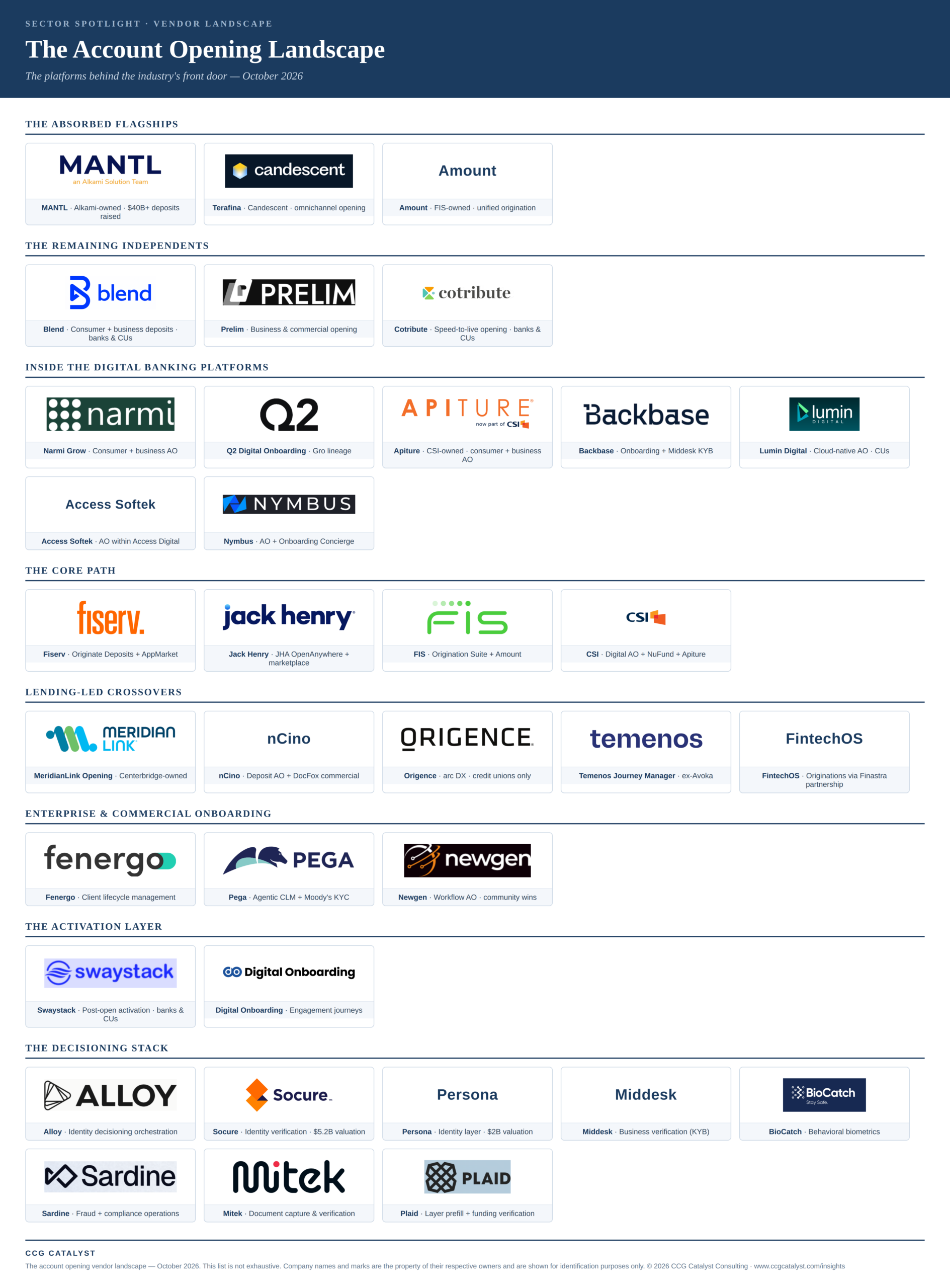
The account opening vendor landscape - October 2026. Company names and marks are the property of their respective owners and are shown for identification purposes only.
This list is not exhaustive and does not include all vendors in the space - if you are a vendor not featured here, please contact us so we can consider updates.
MANTL (Alkami) - still operating as a distinct brand, and still the name to beat. The platform has surpassed $40 billion in deposits raised, covers consumer and business origination, and the finding that should reframe every buyer’s requirements, in-branch account opening emerged as its top growth channel in 2026: the same application, run by a banker at a desk, replacing the paper process. Named recent wins include Amplify Credit Union, Rhinebeck Bank, Austin Telco FCU, and Empower FCU. Core-agnostic, listed on Fiserv’s AppMarket. The diligence question is the ownership one: how MANTL’s roadmap and pricing evolve for institutions that do not run Alkami digital banking.
Website: www.mantl.com
Terafina (Candescent) - the pioneer omnichannel specialist, acquired by NCR in 2021 and carried into Candescent, where it sells as Terafina Digital Account Opening and Onboarding across digital, branch, and call center, consumer and business. The strength is the channel breadth; the question is investment priority inside a private-equity-owned platform with many products competing for the roadmap.
Website: www.candescent.com
Amount (FIS) - the Avant spin-out that built unified deposit, lending, and card origination for consumers and small businesses, acquired by FIS in September 2025 to modernize the FIS Origination Suite. For FIS-core institutions this is the origination roadmap now; for everyone else, watch whether FIS sells it cross-core with conviction.
Website: www.amount.com
Blend (NYSE: BLND) - the largest independent left standing, mortgage-rooted and now squarely in deposits: its consumer banking suite added business deposit account opening in May 2025, and the marquee 2026 win is Frost Bank, which reports application completion rates up 60% - one of the few completion-rate numbers any bank has put its name to, which makes it doubly valuable in a market with no independent benchmarks. Navy Federal selected Blend for membership and deposit accounts in 2023.
Website: www.blend.com
Prelim - San Francisco, the deepest business and commercial account opening workflow among the independents, spanning digital, branch, and back office. Named wins run bank-heavy: Lead Bank in June 2025, Stearns Bank, integrating to Fiserv Premier, in April 2026, plus a Finastra onboarding partnership. Given what happened to every other scaled specialist, treat Prelim’s independence as a snapshot, not a fact of nature, it is the obvious next acquisition target in the category, and your contract should anticipate that.
Website: www.prelim.com
Cotribute - Anaheim-based growth and onboarding layer serving banks and credit unions; Blue Federal Credit Union publicly launched complete online account opening on Cotribute in thirty days, which is the speed-to-live pitch in a single data point. Smaller and less proven at scale than the names above; reference-check accordingly.
Website: www.cotribute.com
Most institutions will meet account opening not as a standalone purchase but as a module of the digital platform they already run or are evaluating - which is exactly how the consolidation wave was designed to make it.
Narmi (Narmi Grow) - consumer and business account opening with decisioning through Alloy and Socure and a new AI assistant for application review; 2026 wins include Northrim Bank, CTBC Bank USA, and North Brookfield Savings Bank on Narmi Grow specifically.
Website: www.narmi.com
Q2 (Q2 Digital Onboarding) - consumer account opening built on the Gro Solutions acquisition, sold alongside the Q2 digital banking platform.
Website: www.q2.com
Apiture (CSI) - consumer and business account opening in its API-first digital platform, now under core-vendor ownership with a stated cross-core posture.
Website: www.apiture.com
Backbase - digital onboarding within its engagement platform, with a Middesk partnership adding real-time business verification.
Website: www.backbase.com
Lumin Digital - account opening within its cloud-native platform, credit-union-led.
Website: www.lumindigital.com
Access Softek - account opening within Access Digital, with Arkansas Best FCU a named January 2026 win.
Website: www.accesssoftek.com
Nymbus - account opening built into its niche digital bank launches, now with a Personal Onboarding Concierge that puts a human in the loop of the digital application.
Website: www.nymbus.com
The buyer’s question for every platform module is the same, is this a competitive account opening product, or a checkbox that exists so you will not evaluate a specialist?
As in digital banking, each core processor sells its own account opening product into its own base, the path of least resistance, and rarely best-of-breed. What is different in this category is that two of the cores now host competing third-party account opening products in their own marketplaces, an acknowledgment in their own storefronts, that their product is not the only answer.
Fiserv - sells Originate Deposits alongside its legacy opening products, and notably, hosts MANTL and Prelim on its AppMarket, an acknowledgment that its own account opening is not the only answer for its cores.
Website: www.fiserv.com
Jack Henry - sells JHA OpenAnywhere, built on the BOLTS acquisition, and exposes third-party account opening integrations through the Banno marketplace - the most deliberately open posture among the cores.
Website: www.jackhenry.com
FIS - sells the Origination Suite across deposits, lending, and cards, now rebuilt around the Amount acquisition.
Website: www.fisglobal.com
CSI - markets digital account opening in its own line, added the NuFund acquisition funnel, and recently bought Apiture, instantly a more credible account opening story for its core base and beyond.
Website: www.csiweb.com
The evaluation logic mirrors the digital layer: the core’s account opening is the path of least resistance, and the honest test is whether it clears the bar the specialists set with the core marketplaces themselves providing the comparison shopping.
A distinct buying pattern deserves its own section: institutions that arrive at deposit account opening through their loan origination system.
MeridianLink - sells MeridianLink Opening, unified with consumer lending, and is newly private under Centerbridge at a $2 billion valuation, which puts the standard private-equity roadmap questions on the diligence list.
Website: www.meridianlink.com
nCino - sells consumer deposit account opening on its Salesforce-based platform, with DocFox brought in for commercial onboarding.
Website: www.ncino.com
Origence - the credit-union-owned CUSO includes account opening in its arc DX origination platform; lending-led, credit unions only.
Website: www.origence.com
Temenos Journey Manager - the former Avoka remains a serious onboarding orchestration product, with MidWestOne Bank a named retail and business onboarding client.
Website: www.temenos.com
FintechOS - the low-code origination layer struck a strategic partnership with Finastra to modernize account originations, a route into the community market through an incumbent’s distribution.
Website: www.fintechos.com
For an institution whose strategic problem is lending-plus-deposits in one flow, this tier can beat the specialists; for pure deposit velocity, it usually cannot.
The large banks do not buy the products above for their commercial and institutional clients, they buy client lifecycle management platforms: banker- and operations-operated systems that manage complex entity onboarding end to end, from multi-layered ownership structures and cross-border KYC through document collection, periodic review, and offboarding. These are seven-figure, multi-year implementations sold to institutions measured in hundreds of billions. A community or regional reader meets this tier in two situations: when commercial growth pushes onboarding complexity past what a deposit account opening platform handles, or when one of these vendors pitches down-market and the price tag needs the context.
Fenergo - the Dublin-based client lifecycle management platform owns much of large-bank commercial and institutional onboarding, with U.S. Bank among its named deployments.
Website: www.fenergo.com
Pega - just launched an agentic AI compliance version of its client lifecycle management product, built with a Moody’s collaboration for KYC data.
Website: www.pega.com
Newgen Software - the workflow platform sells account opening into the community market with named wins - Old Second National Bank and Bank Iowa - that make it the crossover worth watching from this tier.
Website: www.newgensoft.com
The buying logic here is entity complexity: when your commercial clients have layered ownership structures and your onboarding problem is measured in weeks of document collection, this tier is built for it and is generally overbuilt for everything else.
The deep look at this market surfaced a category that was not on our original map, and it answers a question every deposit study raises, opened is not the same as active. An account opened in five minutes and abandoned in month two gathered you a statistic, not a deposit. A distinct vendor tier now works on this problem.
Swaystack - personalized post-opening onboarding and activation: getting the direct deposit moved, the card activated, the app adopted. Signed eleven community banks and credit unions in one announcement this summer, with Oxford Bank and Heritage Valley FCU among named clients; American Banker has covered why small institutions are buying this technology.
Website: www.swaystack.com
Digital Onboarding, Inc. - the Boston company whose name describes the category has run engagement journeys for banks and credit unions for a decade, Navigant Credit Union among its named clients, with a Nymbus partnership extending its reach.
Website: www.digitalonboarding.com
The strategic read: the account opening platforms measure funded accounts, the activation layer measures used ones, and primacy the direct deposit, per everything in this series is won in the ninety days after the open, not in the application. Budget for the door and the welcome.
Accounts open in four channels, not two. Beyond the website and the mobile app sit the branch desk, where a banker runs the application for the customer across from them, and the field, where a business relationship officer opens the operating account at the prospect’s place of business. Both matter more than their share of industry attention might suggest: the branch is where paper processes still consume staff time and produce inconsistent data, and the field is where commercial relationships are actually won. Not every vendor in this Sector Spotlight supports assisted use.
MANTL - in-branch account opening became the platform’s fastest-growing channel in 2026: the same application, run by a banker at the desk. MANTL Business extends the model to the relationship officer in the field.
Terafina (Candescent) - built omnichannel from the start: digital, branch, and call center are standard channels for consumer and business opening.
Prelim - business and commercial opening with branch and back-office workflow; Lead Bank selected it specifically to replace in-branch deposit opening. The strongest documented fit for the relationship-officer scenario.
Jack Henry (JHA OpenAnywhere) - includes an employee channel: Security Bank of Kansas City ran OpenAnywhere through staff after going live online.
nCino (with DocFox) - banker-facing by design: a Salesforce-based platform built for a relationship officer working an entity onboarding from wherever the officer sits.
Blend - its deposit product documentation commits to “a consistent experience across digital, branch, and phone - with banker tools,” delivered through a named Banker Workspace with guided scripting, customer lookup, real-time offers, and pipeline views - capability inherited from its loan-officer-assisted mortgage business.
Fenergo, Pega, and Newgen - employee-operated by definition: client lifecycle management and workflow platforms are banker and operations tools first, which is why they own commercial onboarding at larger institutions.
The following vendors needs to be confirmed during your evaluation process:
MeridianLink Opening - the XpressAccounts heritage was branch-assisted, but the current product page describes a mobile-first digital experience with no branch or assisted-channel language. Whether the assisted capability survives is a question for the demonstration, not an assumption.
Backbase - employee tooling exists at the platform level: front-office workspaces where “customers never repeat themselves, and employees never fly blind,” with branch and relationship-manager capabilities named. The assisted account opening flow specifically is not documented - confirm it.
Q2 Digital Onboarding - the current account opening page describes a digital-first, self-service product and is silent on assisted channels. Confirm the assisted flow, and whether it shares the digital application’s decisioning.
Nymbus - its Onboarding Concierge is the remote variant of assistance: a human joins the digital applicant’s session. Useful, but not the banker-at-the-desk or officer-in-the-field model.
Three requirements separate a working assisted channel from a claim on a slide. One application across every channel, the banker works in the same application as the customer, with the same decisioning and the same funnel reporting, prefilled and resumable, so a stalled digital application can be retrieved and completed at the desk - a separate branch product is a second system to maintain, not a channel. Field-ready business opening: the relationship officer can initiate a business application onsite, with each owner completing identity verification on their own device - without that, the visit still ends in paperwork. And uniform controls: an application a banker starts must route through the same identity and fraud decisioning as one a stranger starts, because an assisted channel that bypasses decisioning is an internal control gap, not a convenience.
One structural truth should shape every evaluation in this category: an account opening platform is an orchestration shell over third-party decisioning, and the third parties are consolidating too.
Alloy - the most embedded identity decisioning orchestrator in the community market; the MANTL-Alloy integration alone has processed more than two million applications.
Website: www.alloy.com
Socure - raised capital at a $5.2 billion valuation in August 2026 and acquired Fravity, an agentic AI operations platform - identity verification is becoming an AI arms race, on both sides.
Website: www.socure.com
Persona - raised $200 million at a $2 billion valuation to build the identity layer for an AI-agent world.
Website: www.withpersona.com
Middesk - the default business-verification (KYB) layer behind business account opening, embedded by Backbase and others.
Website: www.middesk.com
BioCatch - behavioral biometrics at scale; Permira took a majority position at a $1.3 billion valuation.
Website: www.biocatch.com
NeuroID (Experian) - behavioral analytics for application fraud, acquired by Experian.
Website: www.experian.com
Sardine - raised $70 million in early 2025 for AI-driven fraud and compliance operations.
Website: www.sardine.ai
Mitek (NASDAQ: MITK) - document capture and verification; MiSnap capture is offered by four of the top five retail banks.
Website: www.miteksystems.com
Plaid - moved up this stack from funding verification into the application itself: Plaid Layer prefills identity and bank credentials for instant onboarding, and MANTL became the first fintech to offer it in July 2025 - the autofill that erases your typed-question problem may already be in your vendor’s roadmap.
Website: www.plaid.com
ChexSystems (FIS) and Early Warning Services - the two screening utilities that have nearly every deposit decision still touches: ChexSystems the FIS-owned consumer reporting agency, Early Warning the consortium owned by the largest banks. Both are governed by the Fair Credit Reporting Act, which is why your adverse-action letters and your second-chance account policy are part of your account opening design whether you think of them that way or not. The practical consequence for buyers: when a vendor demo “our fraud prevention,” ask which of these engines is actually making the decision, what the per-application data costs are and who bears them, and whether you can swap decisioning providers without replatforming the front door.
If you are a buyer, start where yesterday’s commentary ended: measure your own funnel first, then evaluate every vendor against the four failure points - questions, documents, device breaks, funding.
Conversion reporting as a product requirement: No independent benchmark exists, so the platform’s own analytics are your management system. Demand funnel reporting by screen, channel, and product in the base offering - started, completed, funded - and make the vendor show you a live client’s dashboard, not a mockup. Frost Bank put its name to a 60% completion improvement; ask every finalist what number their reference clients would put their name to.
Business account opening in the demo, not the roadmap: Yesterday’s structural argument lands here. Demand the actual business flow - entity verification, beneficial-ownership collection and certification, multi-owner identity checks, and what happens when an application drops to manual review. The vendors that can genuinely do this - MANTL Business, Prelim, Narmi Grow, Blend since May 2025, nCino with DocFox, Terafina, Apiture, Backbase with Middesk - are few enough to shortlist by name.
Omnichannel means the branch and the field: The most instructive datapoint in this Spotlight is MANTL’s in-branch channel becoming its fastest-growing. The same application prefilled and resumable, whether the customer starts on a phone, a website, across a desk, or in their own office with your relationship officer - and the ability for a banker to rescue a stalled digital application - is what omnichannel actually means. The assisted-channel section above names who has proven it; if the branch flow is a different product, it is not omnichannel.
Decisioning orchestration you control: Risk-based step-up was yesterday’s fraud paradox answer, and it lives or dies in configuration. Ask who sets the rules, whether identity checks run in the background before documents are demanded, which decisioning engines are integrated today, and what it costs - in money and in project time - to change them.
Funding on day one: The application should end with a funded, usable account: instant verification or instant rails, not micro-deposits. A vendor whose funding step still takes days is selling you yesterday’s abandonment problem.
Existing customers get the short path: Per yesterday’s commentary, a logged-in customer opening a second account is not a new identity event. Ask to see that flow specifically - prefilled, three clicks, funded from the existing account, inside digital banking. If the vendor routes your ten-year customer through the public application, the integration to your digital platform is not real.
Ownership, integration, and exit: This market consolidated in eighteen months, and it is not done - the remaining independents face acquire-or-raise decisions on a visible horizon. Ask who owns the roadmap, confirm certified integration to your core and your digital platform (the marketplaces make claims checkable), price per funded account rather than per application, and write data rights and deconversion terms for the owner your vendor will have, not the one it has today.
For expert guidance on selecting and implementing these solutions, consider consulting with firms like CCG Catalyst, who specialize in navigating the financial services ecosystem to match your unique requirements.
Read yesterday’s companion commentary, “Online Account Opening Today” at CCG Insights, along with last week’s pieces on the state of digital banking and the digital banking vendor landscape. Next week the series looks forward: where account opening goes from here, and the future of digital banking through 2035. Reach our team at www.ccgcatalyst.com.
By: Paul Schaus | Founder & Managing Partner, CCG Catalyst Consulting
CCG Catalyst’s Sector Spotlights highlight third-party solutions, products, and the companies that offer them. They provide a snapshot of the innovations, trends, and key players in the financial services ecosystem.