

This Sector Spotlight accompanies our two-part commentary on AI in banking: the model-risk guidance that left generative and agentic AI out of scope, and what protects a bank before governance catches up. Those pieces argue that agents are arriving inside the platforms banks already use, and that their capability is defined by their connections. This landscape maps both layers: agents and connectors.
AI agents for financial institutions are software systems that do not just answer questions but take actions — assembling case files, moving data across systems, and executing multi-step work under human oversight. Connectors are the plumbing underneath: the integration layer, increasingly standardized on Model Context Protocol (MCP), that grants an agent its reach into cores, document stores, and third-party data. The two must be evaluated together, because every connector is an access grant. A bank that inventories its agents but not its connectors has inventoried half the exposure. With this Spotlight CCG Catalyst maps four tiers: the core-provider agent platforms, the independent agent platforms serving community institutions, the connector and data-access layer, and the embedded specialists and oversight tools emerging around them.
Agentic AI in banking is not arriving as a product you go out and buy. It is arriving inside the platforms you already run. In a single stretch this spring, the three major core providers put an agent strategy on the table. Fiserv launched agentOS, an agentic operating system built with OpenAI on AWS Bedrock AgentCore, with First Interstate Bank and Boulder Dam Credit Union already piloting and Salem Five, City National Bank, Bank OZK, and SouthState co-developing the next wave. Days earlier, FIS unveiled a Financial Crimes AI Agent built with Anthropic, with BMO and Amalgamated Bank first in development and general availability set for the second half of 2026. In June, Jack Henry extended its Google Cloud collaboration into an agentic security platform for its roughly 7,400 community institutions. Read the three announcements together and the implication is hard to miss: with the big three serving the large majority of US banks, your provider's AI roadmap is quietly becoming your AI strategy — on their timeline, unless you decide otherwise.
Beneath the agents sits the connector layer, and it is getting far less attention than it deserves. MCP has become the de facto standard for granting agents access to systems and data. Plaid now operates an official MCP server, and the core providers' API ecosystems — Fiserv's Developer Studio and AppMarket, FIS's Code Connect, Jack Henry's Banno Digital Toolkit — are becoming the on-ramps through which agents will reach core data. The National Security Agency issued security guidance on MCP in June 2026, and an unpatched MCP-related flaw was flagged as a banking-sector risk the same month. Meanwhile, the independent platforms serving community institutions are racing to the same ground: Eltropy and Interface.ai each claimed an "industry-first" agentic platform launch within weeks of one another, a reminder that the agentic label is becoming table-stakes marketing language and that evaluation must focus on what the AI actually does in production. The regulatory frame matters too — the April 2026 revised model-risk guidance deliberately placed generative and agentic AI outside its scope, which relocates the evaluation burden onto the institution, not off of it.
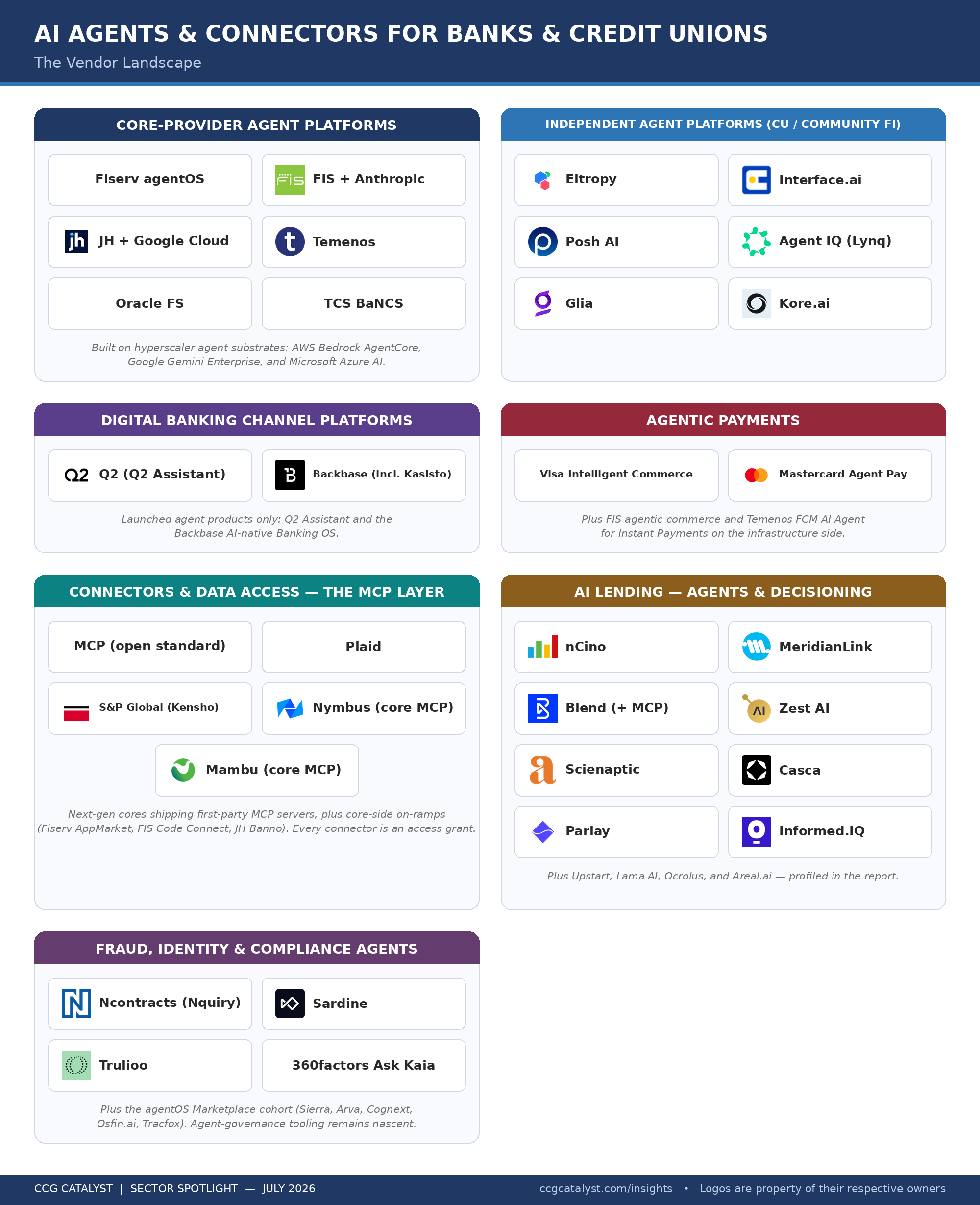
The AI agent and connector landscape for banks and credit unions, July 2026. Logos are property of their respective owners. This list is not exhaustive and does not include all vendors in the space — if you are a vendor not featured here, please contact us so we can consider updates.
Fiserv — agentOS: Launched May 14, 2026, agentOS is an agentic AI operating system that lets banks and credit unions deploy Fiserv-built agents, build their own, or run third-party agents inside one governed architecture, with kill switches, human-in-the-loop checkpoints, permission scoping, and auditability embedded by design. Built with OpenAI and running on AWS Bedrock AgentCore, it launched with four first-party agents (Commercial Loan Onboarding, Daily Operational Analysis and Reporting, Agentic Deposit Intelligence, and Agentic AML Triage) and an agentOS Marketplace with nine inaugural third-party partners including Sardine, Trulioo, and Sierra. First Interstate Bank and Boulder Dam Credit Union are piloting today; Salem Five, City National Bank, Bank OZK, and SouthState are co-developing, with wide availability expected August 2026.
Website: www.fiserv.com
FIS — Financial Crimes AI Agent (with Anthropic): Announced May 4, 2026, FIS is building agentic AI with Anthropic, beginning with a Financial Crimes AI Agent that compresses AML alert and case investigations from days to minutes, assembling evidence across core systems, evaluating activity against known typologies, drafting SAR narratives, and surfacing the highest-risk cases for investigator review. BMO and Amalgamated Bank are first in development, with general availability planned for later in 2026. FIS keeps client data inside FIS-controlled infrastructure with every agent decision traceable, under its "Orchestrated Intelligence" architecture; the roadmap extends to credit decisioning, deposit retention, onboarding, and fraud.
Website: www.fisglobal.com
Jack Henry — with Google Cloud: Jack Henry expanded its Google Cloud collaboration in June 2026 to build a proprietary AI security platform on Google's agentic defense products for its approximately 7,400 community bank and credit union clients, while deploying operational agent use cases — customer service support, insights and reporting, and back-office automation — on the Gemini Enterprise Agent Platform, with early adopters reporting time savings of up to 70% on routine administrative tasks.
Website: www.jackhenry.com
Oracle Financial Services: Oracle has unveiled an agentic AI platform for banking with a large catalog of prebuilt retail and corporate banking agents, spanning loan document analysis and collections-call summarization, extended to corporate banking in spring 2026. Most relevant to larger institutions on Oracle's banking stack.
Website: www.oracle.com/financial-services
Temenos: The Swiss core provider announced Temenos AI Agents, Copilots, and Conversational Studio embedded across its Core, Digital, and Financial Crime Mitigation products in May 2026, alongside a Microsoft integration bringing governed Azure AI agents into Temenos core banking for multi-step workflows in AML and lending, with auditability and human-in-the-loop safeguards. A Tier 1 bank using the Temenos FCM AI Agent is processing hundreds of thousands of sanctions-screening cases and automating over 20% of alerts, and an FCM AI Agent for Instant Payments extends financial-crime controls to real-time payment flows. Notably for this Spotlight's connector theme, Temenos names MCP as one of the four architectural foundations of its AI strategy. Most relevant to US institutions on or evaluating Temenos cores.
Website: www.temenos.com
TCS — BaNCS AI Compass: Tata Consultancy Services pairs its BaNCS core and securities platforms with AI Compass, combining machine learning, generative AI, and pre-built agents to help banking clients adopt responsible AI practices. Relevant primarily to larger institutions on the BaNCS stack.
Website: www.tcs.com
Hyperscaler substrate: Every core-provider agent platform above runs on a hyperscaler agent framework the bank inherits: Fiserv agentOS on AWS Bedrock AgentCore, Jack Henry's operational agents on Google Cloud's Gemini Enterprise Agent Platform, and Temenos' governed agents on Microsoft Azure AI. These alliances determine model flexibility, data residency, and switching costs one layer below the vendor contract — and belong in diligence accordingly.
Q2 — Q2 Assistant: Q2 launched Q2 Assistant in June 2026, a unified AI experience layer embedded across its product portfolio, with a context-aware conversational interface connecting to product-specific agents that execute tasks, beginning with a Customer Care Agent in Digital Banking and with fraud-operations and relationship-pricing agents on the 2026 roadmap, all governed by data isolation, audit logging, and compliance controls. Q2's Innovation Studio also functions as the distribution channel through which third-party agents (Agent IQ among them) reach Q2's bank and credit union base.
Website: www.q2.com
Backbase — AI-native Banking OS (incl. Kasisto): Backbase launched its AI-native Banking OS in April 2026, an operating layer that sits above cores, payments, and CRM where customers, employees, and AI agents work in one model, structured in three layers: Intelligence (signals), Nexus (a shared semantic record every agent and employee reads), and Sentinel — an authority layer that checks every actor's permissions against bank policy before execution and logs each action, a rare productized answer to the defaults-versus-governance problem. Backbase also acquired conversational AI pioneer Kasisto, folding its banking-tuned agents into the platform. Serves 120+ financial institutions with 2025 revenue above $350 million; named clients include Navy Federal Credit Union, TD Bank, and KeyBank.
Website: www.backbase.com
Eltropy: Santa Clara-based unified conversations platform serving 750+ community financial institutions, which launched a governed agentic AI platform for credit unions in March 2026 — a single environment where agents are created, governed, integrated, and deployed under its Safe AI Framework (full visibility into what an agent did, why, with what data, under what authority), with 50+ core and fintech integrations. Named institutions include Credit Union of Texas, InTouch Credit Union, and Cobalt Credit Union (83% session containment on AI voice); fintechs such as Constant AI are building specialized sub-agents on the platform. Acquired Lexop (collections) in early 2025.
Website: www.eltropy.com
Interface.ai: Voice-AI specialist behind the BankGPT platform, serving roughly 100 institutions and processing on the order of 1.5 million conversations daily, with an agentic platform launch in late 2025 focused on contact-center automation for banks and credit unions.
Website: www.interface.ai
Posh AI: Boston-based conversational and voice AI for community banks and credit unions, spanning member-facing digital and phone channels plus employee-facing knowledge tools, with its REALM 2.0 reasoning engine and a notable emphasis on control and auditability, governing responses against approved procedures with visibility into AI behavior.
Website: www.posh.ai
Agent IQ — Lynq: Digital relationship banking platform for community banks and credit unions, founded in 2015 by CEO Slaven Bilac, with roughly $37 million raised across rounds led by Mendon Venture Partners (Series A) and joined by Sierra Ventures, Acronym, FNBO, and the Bankers Helping Bankers Fund. Lynq pairs an AI self-service agent — handling up to 80% of chats with persistent, context-rich conversations that hand off to a chosen personal banker with full history intact — across chat, messaging, video, and co-browsing, plus proactive outreach and real-time banker insights. Distribution is a differentiator: Agent IQ is a Q2 Strategic Alliance partner (resellable directly through Q2) and integrates with Narmi and ebankIT; named institutions include Stanford Federal Credit Union and Bank of Utah, with reported call-center reductions of up to 70%.
Website: www.agentiq.com
Glia: Digital customer service and interaction platform with domain-specific AI for financial institutions, reporting automation rates around 80% on routine inquiries; widely deployed across banks and credit unions.
Website: www.glia.com
Kore.ai: The enterprise-scale option in this tier: an agentic AI platform named a Leader in the Gartner Magic Quadrant for Conversational AI three consecutive years, with 250+ plug-and-play integrations spanning the cores (Jack Henry, Fiserv, FIS, Corelation), digital banking platforms (Q2, Alkami, Banno), card processors, and contact centers, plus a marketplace of 300+ pre-built agents and a governance-first architecture with full audit logging and role-based access controls. The fit question for community institutions is weight versus depth relative to the CU-native specialists above.
Website: www.kore.ai
Visa — Intelligent Commerce: Visa's framework for AI-agent-initiated payments — tokenized, permissioned credentials that let consumer AI agents transact within user-defined controls, developed with the major AI providers. For issuing banks and credit unions, the near-term question is card-not-present risk posture and dispute handling when the "cardholder" is an agent acting on instructions.
Website: www.visa.com
Mastercard — Agent Pay: Mastercard's agentic payments program, built on agentic tokens that extend its tokenization rails to AI-driven transactions with verification of the agent as well as the consumer — the "Know Your Agent" problem arriving in production payments. Issuers should track how agent authentication obligations flow down to the institution.
Website: www.mastercard.com
Infrastructure-side agentic payments: FIS launched an agentic commerce offering for banks following its acquisition of Global Payments' Issuer Solutions business, and Temenos' FCM AI Agent for Instant Payments extends financial-crime screening agents to real-time rails — early markers that the payments stack, not just the storefront, is being rebuilt for agents.
Model Context Protocol (MCP): The open standard — originated by Anthropic and now adopted across major AI providers — that lets agents reach external systems, data, and tools in a structured, permissioned way. It is fast becoming the default plumbing of agentic deployments, which is precisely why it now carries supervisory-grade attention: the NSA issued MCP security guidance in June 2026. For a bank, the practical rule is simple — every MCP connector is an access grant and belongs in the third-party risk inventory alongside the agent it serves.
Plaid: The largest US financial data connectivity network now operates an official MCP server, allowing AI agents to access Plaid data and tooling in real time through remote MCP connections supported by both Anthropic and OpenAI APIs — an early marker of how the aggregation layer becomes the agent layer's data supply.
Website: www.plaid.com
S&P Global — Kensho LLM-ready API & MCP Server: The clearest proven AI connector in financial data: Kensho, S&P Global's AI hub, operates a remote MCP server on its LLM-ready API, giving agents and LLM applications natural-language access to S&P Capital IQ Financials, earnings call transcripts, market data, private company financials, and M&A data, with answers hyperlinked back to the source filings in Capital IQ Pro for auditability, and licensed data explicitly excluded from model training. Listed in Anthropic's MCP Directory as the S&P Global connector and integrated with ChatGPT, Databricks, and Cohere. For bank treasury, credit, and strategy teams adopting AI assistants, this is the pattern to demand from every data vendor: permissioned, source-cited, MCP-standard access.
Website: www.kensho.com
Nymbus — MCP Server: The clearest example of a next-generation core shipping a first-party connector: Nymbus launched its MCP Server in April 2026, one of the first purpose-built for core banking, exposing 19 tools that let AI assistants perform approved core actions — customer lookup, account management, money movement, and debit card controls — through a single conversational interface, with token-based authentication, role-based access controls, PII masking in logs, and full audit logging. Institutions choose which tools are enabled, which roles can use them, and where approval is required. For a community bank or credit union weighing a modern core, this is what "agent-ready" looks like in shipped form rather than roadmap.
Website: www.nymbus.com
Mambu — MCP solution: The cloud-native core has launched an MCP solution (currently in pilot) that abstracts its 300+ API operations behind just two tools — Search, which interprets a natural-language request and returns matching operations with parameter schemas, and Invoke, which executes against Mambu — letting any LLM connect without custom middleware or lock-in.
Website: www.mambu.com
A note on the rest of the next-gen core field: Applying the same evidence standard: Thought Machine (Vault) is genuinely AI-ready — real-time ledger data streaming for AI, cloud-agnostic across all four hyperscalers — but has not shipped a first-party agent or MCP connector; the same holds for 10x Banking. Finxact is part of Fiserv (acquired 2022); its agentic path runs through Fiserv's agentOS platform above rather than a separate product. Architecture that is API-first and agent-ready is not the same as a shipped agent or connector, and this Spotlight lists only the latter.
Core-side connector ecosystems: Fiserv's Developer Studio and AppMarket, FIS's Code Connect API marketplace, and Jack Henry's Banno Digital Toolkit are the core-side on-ramps through which agents — first-party and third-party — will increasingly reach core data. Institutions should treat entitlements in these ecosystems with the same rigor as any production system access.
nCino: nCino has rebranded itself "the platform for agentic AI banking" and shipped role-based agents — its Digital Partners — governed through an Agentic Operating System (AOS) and surfaced through Banking Advisor, its conversational AI. The flagship for lending is the Analyst Digital Partner, a credit-analyst agent launched April 2026 that automates relationship reviews and portfolio risk work inside the Commercial Lending workflow, reportedly cutting review effort 60–70% (one large institution deployed it in 36 minutes). A parallel Mortgage Advisor and Agentic Homeownership Journey cover the retail side. Across 2,700+ institutions; named lending deployments include Vision Credit Union and DNB. For a bank or credit union already on nCino, the agent inherits the platform's workflow, identity, and data model — a real shortcut, at the cost of platform commitment.
Website: www.ncino.com
MeridianLink — Intelligence ("Millie"): MeridianLink launched MeridianLink Intelligence in May 2026, an embedded AI layer deploying role-based agents inside its MeridianLink One platform for community banks and credit unions. The first agent, Doc Agent for Mortgage, automates document collection, review, and follow-up (general availability targeted for Q4 2026, with a Consumer version in early 2027) — the opening move in a planned suite of task-specific agents across the lending lifecycle. Positioned on being the system of record: 30 years of workflow data and embedded compliance logic rather than a bolt-on.
Website: www.meridianlink.com
Blend — Autopilot & Autopilot MCP: Blend is the rare lending vendor shipping both an agent and a connector. Autopilot, its agentic AI for mortgage pre-underwriting, reached its first commercial customers in July 2026 after a four-month preview across more than 25,500 real loans; five lenders including Onity Mortgage went live, with Autopilot reviewing documents as borrowers upload them, calculating GSE-qualifying income, and generating contextual follow-ups in real time. Alongside it, the Autopilot MCP Server (live in beta since April 2026) exposes Blend's full origination stack — credit, pricing, AUS, disclosures, compliance, conditions — through one standardized interface, letting lender- and partner-built agents execute across the loan lifecycle with per-tenant access gating, isolated credentials, and a full audit trail. This is the connector layer arriving inside lending itself.
Website: www.blend.com
Zest AI: AI credit underwriting with deep credit union penetration, more than 250 financial institution clients offering machine-learning decisioning models with fair-lending documentation, fraud scoring, and a generative AI lending-intelligence assistant. Backed by growth investment led by Insight Partners. The category leader for institutions that want AI in the credit decision itself, which places it squarely inside the fair-lending exposure discussed below.
Website: www.zest.ai
Upstart: AI lending marketplace and underwriting platform used by 100+ bank and credit union partners for personal, auto, and HELOC lending. The buy-the-outcome alternative to building AI underwriting, with the corresponding diligence questions on model transparency and partner-program concentration.
Website: www.upstart.com
Scienaptic AI: AI credit decisioning purpose-built for US credit unions and mid-market banks, structured as a CUSO backed by 17 strategic (client) investors. Its platform processes over 3 million credit decisions a month across institutions managing $3.9 trillion in assets, with documented automated-decisioning lifts (one mid-market CU moved from 28% to 75% auto-decisioning). Its iCUE release folds large language models and agentic AI into the decisioning layer, and an April 2026 native integration puts Scienaptic's decisioning signals directly inside the Temenos loan-origination workflow, no rip-and-replace. Named users include Credit Union of Colorado, Barksdale FCU, and 4Front CU.
Website: www.scienaptic.ai
Casca: AI-native loan origination for business and SBA lending — an agent that ingests tax returns, bank statements, and financial statements, spreads the numbers, and drives applications toward a decision through 30+ native data integrations, reducing cycle times by days. Raised a $29M Series A backed by Live Oak Ventures; Live Oak Bank and Huntington are integrating its generative AI tools for SBA 7(a) lending. Profiled in depth in our companion Sector Spotlight on SBA 7(a) underwriting technology.
Website: www.cascading.ai
Parlay — Loan Intelligence System: The loan-readiness layer at the top of the SBA funnel: an AI-native Loan Intelligence System that sits beside the incumbent LOS, qualifying and packaging small business applications before they reach a decision — real-time borrower onboarding, user-permissioned data capture, document validation, cross-referenced financial statements, and AI-powered analysis for the lending team, capturing decisioning patterns as institutional intelligence rather than merely recording transactions. Backed by a $2 million seed led by JAM FINTOP, whose network of bank investors doubles as distribution, with partnerships spanning Mastercard Small Business and credit-decisioning firm Stratyfy; founder-led by CEO Alex McLeod. Named clients include Locality Bank and First Internet Bank, which deployed the system across its SBA operation in October 2025 and anticipates efficiency gains of up to 50%. Profiled alongside Casca in our companion Sector Spotlight on SBA 7(a) underwriting technology.
Website: www.parlay.finance
Lama AI: AI-native loan origination platform for community and regional banks, built around modular agents spanning intake, document collection, spreading, underwriting, decisioning, approval, closing, and portfolio monitoring — and explicitly API-first, with an Exchange API for banks and fintechs to build lending products on top. In production at institutions including SouthState Bank, Colony Bank, and Gate City Bank, having processed billions in loan volume.
Website: www.lama.ai
Informed.IQ: The most advanced agentic implementation in lending verification — vertical AI agents that automate income and employment verification, document intelligence, fraud detection, and compliance checks across the loan lifecycle, trained on a proprietary dataset of 2 billion-plus data points from over 100 million loan documents, with an AI copilot giving loan officers human-in-the-loop review that feeds model improvement. Founded in 2016, raised $63 million in December 2025 led by Invictus Growth Partners (after Nyca Partners and US Venture Partners). Used by seven of the top ten US auto lenders, supporting $350 billion-plus in originations; Westlake Financial credits it with catching GenAI-fabricated applications worth double-digit millions annually. Reaches banks and credit unions through LOS integrations including Origence (1,100+ credit unions and the CUDL dealer network) and MeridianLink.
Website: www.informediq.com
Ocrolus: AI document automation with a human-in-the-loop verification layer for income, asset, and identity documents — the data-quality tier that determines whether a downstream decisioning agent is acting on trustworthy inputs, with fraud detection where manipulation risk is high. Widely embedded across consumer, mortgage, and small-business lending.
Website: www.ocrolus.com
Areal.ai: A mortgage-operations AI whose Copilot Agent — one of the first agentic platforms purpose-built for mortgage — runs from borrower onboarding through closing (asset and income review, insurance, appraisal, title, funding, post-closing), understanding 1,500+ mortgage document types at high field accuracy. Now a native integration on MeridianLink, with named users including the Guaranteed Rate companies and Canopy Mortgage.
Website: www.areal.ai
Ncontracts — Nquiry Ntelligence: Launched May 4, 2026 by the Nashville-based GRC provider serving 5,000+ financial organizations: a purpose-built compliance AI agent delivering cited, auditable answers to regulatory questions in minutes, trained on 17 years of anonymized audit and compliance findings verified by former regulators and attorneys. Two design choices stand out against the pattern this Spotlight describes: Compliance Concierge, a built-in human-in-the-loop escalation to credentialed experts (currently triggered in roughly 10% of sessions), and a 90-day money-back accuracy guarantee — the only one in the compliance AI market. Pairs with Ncomply to answer against the institution's own policies alongside the regulatory sources, and sits inside Ncontracts' integrated vendor-management and ERM suite.
Website: www.ncontracts.com
agentOS Marketplace partners: The inaugural third-party agent builders on Fiserv's marketplace signal where specialist agents will concentrate: Sardine (fraud and compliance intelligence), Trulioo (identity verification), and Sierra (AI customer engagement), among nine launch partners including Arva, Cognext, Osfin.ai, and Tracfox — with dispute management, reconciliation, deposit intelligence, and regulatory compliance among the launch use cases.
360factors — Ask Kaia: GRC-native compliance agents, including a Federal Register Tracker and Regulatory Impact Analyzer that operate inside the governance system of record and generate audit trails as they work; representative of the compliance-side pattern of agents constrained to procedural, auditable tasks.
Website: www.360factors.com
A candid note on agent governance tooling: Dedicated third-party tooling for governing agents — agent inventories, drift detection, connector entitlement review — remains nascent relative to the deployment wave. The platform vendors' embedded controls (kill switches, human-in-the-loop checkpoints, permission scoping) are real, but they are defaults, not governance: they answer what an agent can do, not what your institution should allow, who owns the risk, or how drift gets detected. That work currently falls to the institution.
If you are a buyer, ensure you have defined business and functional requirements and recognize that the object of evaluation has shifted from the model to the whole operating system around it. When every vendor response says "AI," the task is separating real capability from a good demonstration.
Auditability by Design: Every agent action should be traceable — what it did, why, with what data, under whose authority — and with source-linked conclusions. It also needs to preserve human override history. Agents that dazzle in a sales demo routinely break in an audit.
Connector Inventory: Demand a complete map of what the agent can reach — every MCP server, API entitlement, and data store — and fold it into third-party risk management. An agent's real capability is defined by its connections, and so is its blast radius.
Human-in-the-Loop Placement: Where does a human own the final action, and is that placement configurable to your risk appetite? Recommend-and-document postures (as in FIS's financial-crimes design) differ materially from agents empowered to act.
Defaults vs. Governance: Vendor controls tuned for a thousand institutions will be examined against exactly one — yours. Assign ownership of kill switches, review permission scoping after go-live, and define drift detection; a kill switch nobody watches is furniture.
Fair-Lending and Consumer-Impact Exposure: Identify every point where agent output feeds a decision covered by fair-lending or UDAAP obligations and hold those paths to model-risk-grade validation — even though the revised guidance leaves agentic AI formally out of scope, the agencies kept their full authority over unsafe or unsound practices.
Vendor Lock-In and Model Flexibility: Ask which foundation models the platform can run, what happens to your workflows if the AI partnership changes, and whether agents built in one ecosystem are portable. The core providers' model alliances — OpenAI, Anthropic, Google — are strategic bets the bank inherits.
For expert guidance on evaluating these solutions and building the governance to run them safely, consider consulting with firms like CCG Catalyst, who specialize in navigating the financial services ecosystem to match your unique requirements.
See our latest announcement: CCG Catalyst's Paul Schaus Named a 2026 Top Consultant by Consulting Magazine
By: Paul Schaus | Founder & Managing Partner, CCG Catalyst Consulting
CCG Catalyst's Sector Spotlights highlight third-party solutions, products, and the companies that offer them. They provide a snapshot of the innovations, trends, and key players in the financial services ecosystem.