

Dual-ledger technology — also called the twin ledger, synthetic ledger, or sidecar — is the machinery that lets a sponsor bank independently know, beneficial owner by beneficial owner, who is owed what inside its omnibus FBO accounts, whichever program manager, fintech or otherwise, gathered the funds. It spans bank-side subledgers, virtual account management, parallel "sidecar" cores, ledger infrastructure APIs, and the reconciliation and oversight layer above them all. Done well, it is the difference between a bank that holds fintech program deposits and a bank that merely hosts them; done badly, or left to the fintech's ledger alone, it is how four banks froze over 100,000 customers out of their own money.
As we argued in yesterday's commentary, the dual ledger is a de facto supervisory and market expectation with no de jure home:
| Layer | What it requires | Status |
|---|---|---|
| FDIC proposed rule, 12 CFR Part 375 (Oct 2024) | Bank-maintained or continuously accessible beneficial-owner records, daily reconciliation, standardized file format, annual certification | Proposed only — shelved as a "long-term action." Never finalized, never withdrawn |
| Pass-through insurance records rules, 12 CFR 330.5/330.7 | Custodial capacity in the bank's account titling; owner detail ascertainable from bank or third-party records | Binding — and it expressly permits the ledger to sit at the fintech. The gap Synapse fell through |
| July 2024 interagency joint statement | Names "lack of access to records" a core risk; bank access and contingency rights to the deposit system of record | Supervisory expectation; still in effect |
| ROAD to Housing Act §901 (July 2026) | Custodial deposits excluded from brokered treatment up to 20% of liabilities | Binding statute — with zero recordkeeping conditions attached |
| Consent orders (Evolve, Thread, Lineage) | Defined ledger and sub-ledger responsibilities "including in the event of a material business disruption"; documented beneficial ownership | Binding on the named banks only |
Read the table bottom-up and the buying case writes itself. The controls are being installed bank by bank through enforcement rather than by rule; the new statutory safe harbor makes these deposits more attractive without making them safer; and the shelved FDIC rule — whose own cost estimate was roughly $220,000 per bank to stand up — remains the blueprint examiners reach for. Building to Part 375 voluntarily is the cheapest position available. It satisfies the joint statement, preempts the consent order, and future-proofs against the rule waking up. That is the specification the vendors below sell against.
Three currents shape the 2026 market. First, consolidation reached the category fast: Jack Henry acquired Victor — the virtual-account platform built inside sponsor bank MVB — in October 2025; CSI acquired Qolo in July 2026, months after Qolo's KeyBank partnership and Huntington alignment; and Synctera acquired Cable, the automated control-testing platform, in April 2026. Core vendors are buying their way into bank-side ledgering, which tells you where they think the requirement is headed. Second, the middleware repositioned as bank software: Treasury Prime's Bank-Direct pivot sells the stack to the bank rather than around it, and the post-Synapse program migrations — Mercury and Brex to Column, Stripe to Fifth Third's Newline — all ran toward banks that own their infrastructure. Third, the sponsor-bank market grew through the reckoning, from roughly 142 banks to 156 during 2025. The demand side of this category is expanding, not retreating, and it is concentrating among banks that treat program visibility as a product.
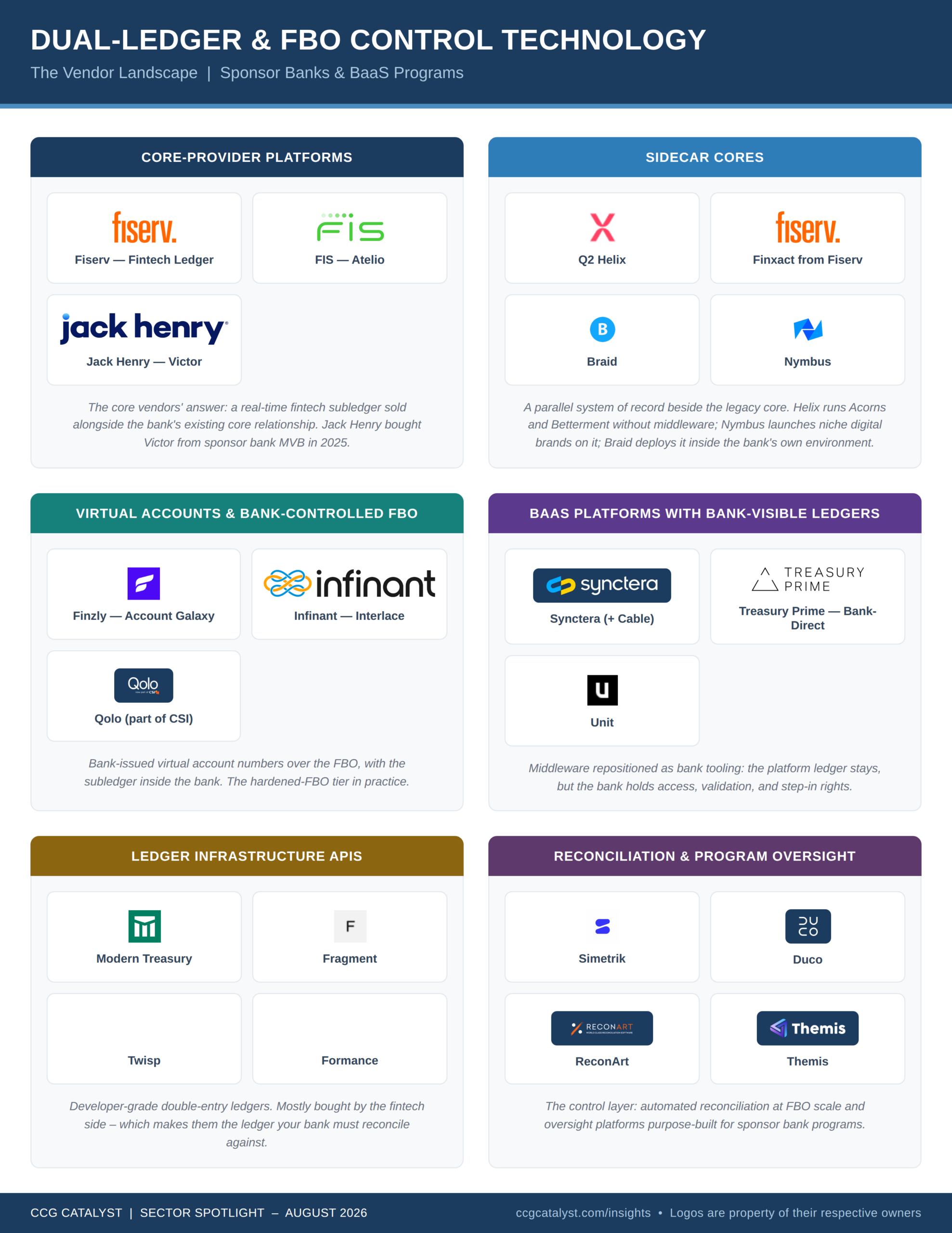
The dual-ledger and FBO control technology vendor landscape, August 2026. Logos and company names are the property of their respective owners and are shown for identification purposes only. This list is not exhaustive and does not include all vendors in the space — if you are a vendor not featured here, please contact us so we can consider updates.
Fiserv — Fintech Ledger: The largest core vendor's real-time, open system of record for embedded finance programs, positioned alongside Finxact and Cleartouch as the ledger layer of Fiserv's fintech stack. The strategic read: the vendor that already runs the bank's core now sells the subledger that reconciles to it, which collapses the integration question that dogs every third-party option.
Website: www.fiserv.com
FIS — Atelio: FIS's API-driven embedded finance platform for banks, launched May 2024, with an explicit side-core positioning and an accounts product. Publicly named users are fintech-side to date, and the platform has been quiet since launch — the diligence question is traction, not capability.
Website: www.atelio.com
Jack Henry — Victor: Jack Henry acquired Victor Technologies from MVB Financial in October 2025 — a virtual-account and payments platform built inside a sponsor bank, now folded into Jack Henry's payments-as-a-service strategy. Worth noting the provenance: this is bank-born tooling, built to solve the operator's own problem, which is exactly the pedigree you want in this category.
Website: www.jackhenry.com
Q2 Helix: The longest-running US sidecar core for consumer fintech deposit programs, owned by Q2 Holdings — a cloud-native system of record for customers, accounts, balances, and transactions at the bank of record, serving Acorns, Betterment, Credit Karma, and Gusto at a stated ten-million-plus users without middleware. The direct-model mechanics without replacing the legacy core.
Website: helix.q2.com
Nymbus: The US-native fourth-generation core with the clearest sidecar track record in community banking: a cloud core plus a launch model for niche digital brands, letting a bank or credit union stand up a separately branded deposit business on a modern system of record beside the legacy core. Insight Partners-backed; clients include PeoplesBank — the largest US community bank to fully adopt a modern core — and Vantage West Credit Union's niche-brand launch. For a bank whose program strategy is its own digital brands rather than third-party fintechs, this is the sidecar architecture with the most domestic proof.
Website: www.nymbus.com
Braid: Privately held early-stage entrant that takes the sidecar idea one step further: the software deploys into the bank's own environment, its phrase is "they become the fintech," as a separate ledger with its own routing number, reconciling to the bank's core at the general ledger daily. Programs and products map to FBO accounts with virtual accounts underneath, each carrying its own ledger and balance, and every program structure requires the bank's approval by design. Aimed at community banks and credit unions from roughly $50 million in assets up and positioned explicitly as the anti-middleware: fee income and deposit growth without a BaaS intermediary between the bank and the program. Early-stage diligence applies — small company, angel-backed — but the architecture is the purest expression of bank-owned ledgering in this Spotlight.
Website: www.braidfi.com
Finxact from Fiserv: The cloud core Fiserv acquired for $650 million in 2022, deployed by banks including First Horizon and Live Oak in both sidecar and full-core modes. The category's proof that a parallel system of record is a mainstream bank architecture rather than a fintech workaround.
Website: www.finxact.com
The global fourth-generation cores — a watch list: Thought Machine (Vault), Mambu, 10x, Tuum, and Visa-owned Pismo are real technology with marquee names — Thought Machine counts JPMorgan Chase and Arvest among its clients — but none has a public US sponsor-bank or FBO-program deployment, and their center of gravity is large-bank core modernization abroad. Architecturally capable of the sidecar role; commercially unproven in this category in the US. Evaluate them as core-modernization vendors, not as program-ledger vendors, until a domestic reference exists. A domestic name in the same posture: Open Banking Solutions, whose low-cost CloudCore platform — built by veterans of the DNA core — is architecturally suited to sidecar deployment.
Finzly — Account Galaxy: Charlotte-based, privately held payments specialist whose Account Galaxy product issues virtual accounts with a real-time virtual ledger sitting beside any core — bank-side visibility into FBO programs at the transaction level. Bank clients include Vantage Bank and Quaint Oak Bank.
Website: www.finzly.com
Infinant — Interlace: Charlotte-based, purpose-built for banks to run embedded finance programs "above the core" with bank-controlled virtual accounts and ledgering. Named banks include Valley Bank, Customers Bank, Vantage Bank, and Live Oak — a client list that reads like a who's-who of serious sponsor banking.
Website: www.infinant.com
Qolo (part of CSI): Virtual account management with real bank validation, a KeyBank partnership and strategic investment, and a Huntington alignment — acquired by core vendor CSI in July 2026. The acquisition is the point: bank-grade VAM is now a core-vendor capability, which validates the category and raises the roadmap-independence question we ask in every Spotlight.
Website: www.qolo.io
Synctera: The platform that is most explicit about the ledger problem — its architecture makes the platform ledger the system of record with the bank core holding the FBO mirror, and its April 2026 acquisition of Cable adds automated control testing and account-level compliance verification. Banks include Midland States Bank and Lineage. The model works precisely to the degree the bank exercises its access, validation, and step-in rights — which is the contract negotiation, not the demo.
Website: www.synctera.com
Treasury Prime — Bank-Direct: The 2024 pivot that defined the middleware repositioning: selling the embedded-banking operating system to the bank, with dedicated per-fintech FBOs, per-rail settlement accounts, and real-time reconciliation. Since the pivot it has joined U.S. Bank's partner network and added banks including Coastal and i3 to its network.
Website: www.treasuryprime.com
Unit: Active and repositioned toward embedded finance for vertical software companies, with a bank-direct product since 2024. Include it in an evaluation with the caveat that its buyer is historically the platform, not the bank.
Website: www.unit.co
Modern Treasury: The category-defining payment operations and ledger API — ledgers, payments, and a reconciliation engine — bought overwhelmingly by the fintech and corporate side (Gusto, Robinhood, Anchorage Digital). For a bank, its significance is usually as the counterparty system: the professionally built ledger your program partners run, and the one your sidecar reconciles against.
Website: www.moderntreasury.com
Fragment, Twisp, Formance: The developer-grade double-entry ledger tier — Fragment serving fintechs including Bill and Ramp; Twisp, the independent cloud core-ledger (contrary to occasional industry chatter, not acquired by anyone); and Formance, the open-source ledger platform that raised a $21 million Series A in January 2025. Watch-list entries for a bank Spotlight: real technology, thin bank distribution so far.
Websites: fragment.dev, twisp.com, formance.com
Simetrik: AI reconciliation platform backed by roughly $85 million from Goldman Sachs-affiliated investors, scaling into the US and notably publishing directly on FDIC Part 375 custodial recordkeeping compliance. The strongest new entrant marketing specifically to the FBO reconciliation problem.
Website: www.simetrik.com
Duco: Enterprise data-automation and reconciliation, owned by Nordic Capital, with bank clients including HSBC, ING, Northern Trust, and Citizens. Not FBO-specific — it is the industrial-strength option for banks whose reconciliation problem extends well beyond a fintech program.
Website: www.du.co
ReconArt: The mid-market reconciliation workhorse, privately held, Virginia-based, in market since 2011, with bank clients including Umpqua and Choice.
Website: www.reconart.com
Themis: Compliance collaboration purpose-built for bank-fintech programs, with a sponsor-bank client roster — NBKC, Piermont, Sunrise, FinWise, Blue Ridge, Hatch — that maps almost exactly onto the banks that lived through the 2024 consent-order cycle. Oversight rather than ledgering, and the natural complement to it.
Website: www.themis.com
If you are a sponsor bank or about to become one, start where yesterday's commentary ended: build to the shelved FDIC rule voluntarily, because it is the only written specification this category has, and everything an examiner will ask for is in it. And buy rather than build — a homegrown twin ledger is shelfware the day it goes live, with one internal customer and no roadmap, which is precisely why this vendor category exists.
For expert guidance on selecting and implementing these solutions, consider consulting with firms like CCG Catalyst, who specialize in navigating the financial services ecosystem to match your unique requirements. For yesterday's companion commentary and the full library, see CCG Insights.
See our latest announcement: CCG Catalyst's Paul Schaus Named a 2026 Top Consultant by Consulting Magazine
CCG Catalyst's Sector Spotlights highlight third-party solutions, products, and the companies that offer them. They provide a snapshot of the innovations, trends, and key players in the financial services ecosystem.