The trust operations category rewards that discipline more than most — it is a small market, an aging one, and, as we argued in yesterday's commentary, one that is suddenly strategic. The charter gold rush and the great wealth transfer are converging on infrastructure that has not had a competitive refresh in a generation.
Trust operations technology comprises the systems a bank trust department or trust company runs the fiduciary business on — trust accounting and the fiduciary book of record, tax preparation and filing, estate settlement and administration workflow, client reporting, and increasingly the custody infrastructure for digital assets held in fiduciary accounts. Unlike retail core banking, where three providers serve most of the market and modernization is a board-level topic, trust technology is a quiet corner: a short vendor list, long product lineages, nightly batch cycles, and replacement cycles measured in decades. Done well, the stack is the operating leverage behind fee income that compounds across generations; done poorly, it is the reason a trust department cannot serve the heirs.
What's Going On in Trust Operations Technology
Three forces are converging on this category at once. First, demand: the $124 trillion wealth transfer is pushing estate settlement, trusteeship, and fiduciary administration volumes toward institutions whose systems were not built for the load — or for heirs who expect digital access. Second, competition: the national trust charter pipeline has reached twenty-one institutions in under nine months, and the newcomers — Circle, Ripple, Fidelity Digital Assets, now Morgan Stanley and Nomura's Laser Digital — are building fiduciary infrastructure that is API-native from day one. Third, consolidation and alliance activity has reached even this quiet corner: SS&C absorbed Innovest's trust platform; Accutech Systems, one of the longest-tenured independents, renamed itself Cheetah after its flagship platform; and Fi-Tek and BetaNXT launched TrustWealthX in 2025, stitching trust, brokerage, and wealth reporting into one offering. Meanwhile a new layer is forming above the systems of record: AI-driven estate intelligence platforms that read, map, and model trust documents — selling, as the new entrants always do, what makes the system of record worth having.
Trust Operations Technology Vendor Snapshot
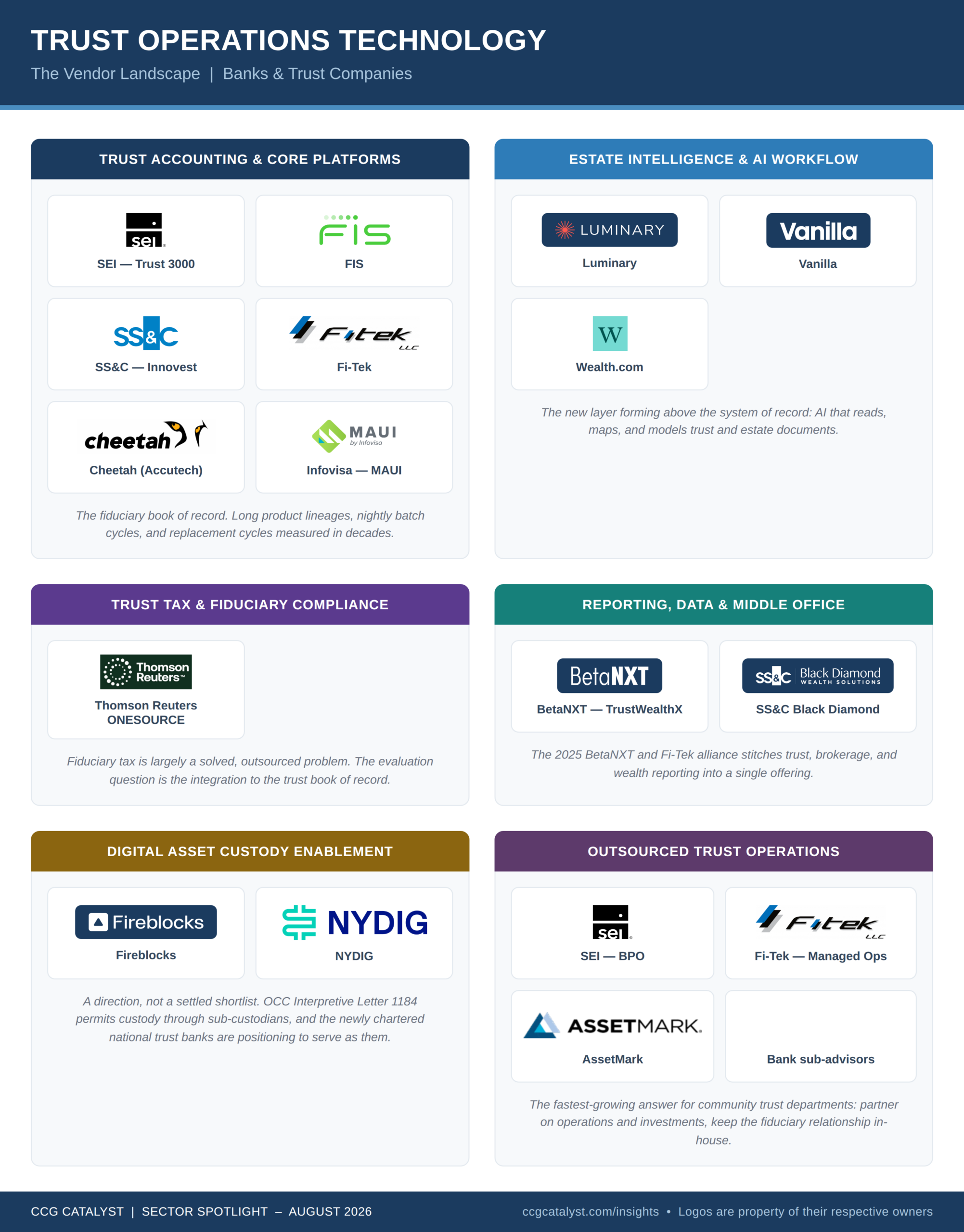
The trust operations technology vendor landscape, August 2026. Logos and company names are the property of their respective owners and are shown for identification purposes only. This list is not exhaustive and does not include all vendors in the solution space — if you are a vendor not featured here, please contact us so we can consider updates.
Trust Accounting & Core Platforms
- SEI: The scale incumbent. Trust 3000 has been the workhorse fiduciary book of record for large bank trust operations for decades, with the SEI Wealth Platform as its modernization path and a full business-process outsourcing model for institutions that want the operations off their floor entirely. The evaluation question at SEI is rarely capability — it is the migration path, the outsourcing economics, and how much operating control the institution wants to retain. Website: www.seic.com
- FIS: The core-provider entrant, with trust and wealth accounting platforms carrying SunGard lineage and the distribution advantage of the broader FIS relationship. The consideration mirrors every core-provider module we cover: integration gravity is real, and so is the question of where trust sits on a very large company's investment priority list. Website: www.fisglobal.com
- SS&C — Innovest: SS&C Technologies acquired Innovest Systems and with it InnoTrust, a modern browser-based trust accounting and wealth platform serving trust companies, private banks, and retirement organizations, now flanked by SS&C's broader wealth stack, including Black Diamond's trust services capabilities. The ownership pattern to weigh: SS&C is one of the most acquisitive companies in financial software, and roadmap independence inside a large portfolio is always the diligence question. Website: www.ssctech.com
- Fi-Tek: Privately held, Edison, New Jersey-based specialist whose trust bank suite — TrustPortal and the Global WealthES platform — serves bank trust departments and trust companies with accounting, workflow, and client portals, plus outsourced operations for institutions that want the middle office handled. Its 2025 TrustWealthX alliance with BetaNXT extends the platform across trust, brokerage, and wealth reporting — evidence of active investment from one of the category's remaining independents. Website: www.fi-tek.com
- Cheetah (formerly Accutech Systems): Muncie, Indiana-based independent, founded in 1987, which took the name of its flagship platform in 2023. Cheetah is a cloud-based trust and wealth administration platform aimed squarely at community bank trust departments and independent trust companies — the segment the enterprise platforms price past. One of the few remaining founder-lineage independents in the category, which cuts both ways: no private-equity clock, and no parent balance sheet either. Website: www.accutechsystems.com
- Infovisa: Independent North Carolina-based provider of the MAUI trust accounting platform, serving community bank trust departments and trust companies with accounting, document management integration, and administration tools. Like Cheetah, it competes on fit and service in the segment below the enterprise platforms' economics. Website: www.infovisa.com
Trust Tax & Fiduciary Compliance
- Thomson Reuters — ONESOURCE Trust Tax: The de facto standard for fiduciary tax — software and outsourced preparation for the 1041s, K-1s, and state filings that consume trust operations every spring. Most institutions treat fiduciary tax as a solved, outsourced problem; the evaluation question is the integration between the tax engine and the trust accounting book of record, because rekeying between them is where errors and overtime live. Website: tax.thomsonreuters.com
Estate Intelligence & AI Workflow — The Fintech Edge
- Luminary: The clearest example of the new layer forming above the trust book of record: an AI-powered trust and estate platform that digitizes estate documents, maps plans into dynamic visualizations, and models wealth-transfer scenarios — built for wealth advisors, family offices, trust companies, and enterprise financial institutions. Its published client roster includes BNY, Focus Financial, Wealth Enhancement, and Carson — evidence the enterprise segment is buying. The strategic read: platforms like this do not replace trust accounting; they make the fiduciary relationship legible to the next generation, which is precisely where incumbent trust departments are weakest. Watch-list peers in the adjacent advisor-facing estate category include Vanilla and Wealth.com. Website: www.withluminary.com
Digital Asset Custody Enablement
This category is younger and moving fast, so treat it as a direction rather than a settled shortlist. With the OCC confirming that digital asset custody sits within banks' existing custody authority — including through sub-custodians — the practical route for a trust department is partnership: custody-technology and sub-custody providers supply the wallets, key management, and controls, while the bank keeps the fiduciary relationship. The infrastructure names recurring in bank arrangements include Fireblocks and NYDIG on the technology and sub-custody side, and the newly chartered national trust banks are positioning to serve as sub-custodians themselves. Apply startup-grade diligence and the full third-party framework here: this is the newest corner of the category, and the certification infrastructure for it is still being built.
What to Look For in Trust Operations Technology
If you are a buyer, start where our trust commentary ended — decide whether you are investing in the trust business, partnering to scale it, or exiting — because the right stack depends entirely on that answer, and the most expensive mistake is a full modernization ahead of an exit.
- Ownership and Roadmap: The pattern from every Spotlight repeats here — SS&C answers to public markets and an acquisitive model, SEI and FIS to public markets at scale, Fi-Tek, Cheetah, and Infovisa to private owners. Ask who owns the roadmap, what the exit horizon implies, and how much of the vendor's revenue trust represents.
- Integration with the Bank: Trust systems have historically lived on an island. Ask for named, referenced integrations to your core, your general ledger, your CRM, and your digital banking — and price the island tax if they do not exist.
- Estate Settlement Workflow: The wealth transfer is an estate-settlement volume story. Evaluate the workflow for onboarding an estate, administering unique assets, and distributing to beneficiaries — not just the accounting.
- Heir-Facing Experience: The account holder of the next decade expects a portal, not a quarterly statement. Demand the beneficiary and grantor experience in the demo, not the trust officer's screen.
- Digital Asset Readiness: Ask specifically how the platform records, values, and reports digital assets held in fiduciary accounts, and which custody partners it integrates with. A trustee who cannot administer the asset class cannot settle the estate that contains it.
- Outsourcing Economics: Model license-and-staff against full operations outsourcing honestly, including the talent risk of the in-house path — trust operations expertise is retiring faster than it is being replaced.
- Data Rights and Exit: Fiduciary records span generations; your data will outlive your vendor relationship. Demand unrestricted extraction rights, standard formats, and capped deconversion fees before you sign.
For expert guidance on selecting and implementing these solutions, consider consulting with firms like CCG Catalyst Consulting, who specialize in navigating the financial services ecosystem to match your unique requirements.
CCG Catalyst's Sector Spotlights highlight third-party solutions, products, and the companies that offer them. They provide a snapshot of the innovations, trends, and key players in the financial services ecosystem.